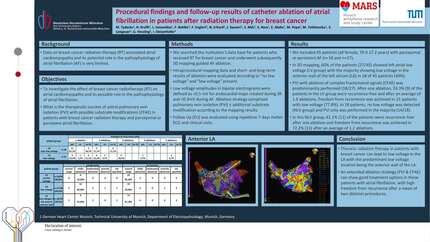
Procedural findings and follow-up results of catheter ablation of atrial fibrillation in patients after radiation therapy for breast cancer
European Heart Journal


Abstract
Data on breast cancer radiation therapy (RT) associated atrial cardiomyopathy and its potential role in the pathophysiology of atrial fibrillation (AF) is very limited.
To investigate the effect of breast cancer radiotherapy (RT) on atrial cardiomyopathy and its possible role in the pathophysiology of atrial fibrillation. What is the therapeutic success of antral pulmonary vein isolation (PVI) with possible substrate modifications (CFAE) in patients with breast cancer radiation therapy and paroxysmal or persistent atrial fibrillation.
We searched the institution’s data base for patients who received RT for breast cancer and underwent subsequently 3D mapping guided AF ablation. Intraprocedural mapping data and short- and long-term results of ablation were evaluated according to "no low voltage" and "low voltage" present. Low voltage amplitudes in bipolar electrograms were defined as <0.5 mV for endocardial maps created during SR and <0.3mV during AF. Ablation strategy comprised pulmonary vein isolation (PVI) ± additional substrate modification according to the mapping results. Follow Up (FU) was evaluated using repetitive 7-days Holter ECG and clinical visits.
We included 45 patients (all female, 70.9±7.2 years) with paroxysmal or persistent AF (n=18 and n=27). In 3D mapping, 60% of the patients (27/45) showed left atrial low voltage (LV group) with the majority showing low voltage in the anterior wall of the left atrium (LA) in 18 of 45 patients (40%). PVI with ablation of complex fractionated signals (CFAE) was predominantly performed (18/27). After one ablation, 33.3% (9) of the patients in the LV group were recurrence-free and after an average of 1.9 ablations, freedom from recurrence was achieved in 21 patients with low voltage (77.8%). In 18 patients, no low voltage was detected (NLV group) and PVI only was performed in the majority (14/18). In this NLV group, 61.1% (11) of the patients were recurrence-free after one ablation and freedom from recurrence was achieved in 72.2% (13) after an average of 1.2 ablations.
Thoracic radiation therapy in patients with breast cancer can lead to low voltage in the LA with the predominant low voltage location being the anterior wall of the LA. An extended ablation strategy (PVI & CFAE) can show good treatment options in these patients with atrial fibrillation, with high freedom from recurrence after a mean of two ablation procedures. Freedom from recurrence after ablation Characteristics of left atrium (LA)
Contributors

H Krafft
Author
L Iamanidze
Author
F Bahlke
Author
F Englert
Author
N Erhard
Author
J Syvaeri
Author
E Abdiu
Author

M Telishevska
Author
S Lengauer
Author


You may be interested in