
Doctor Miruna-Andreea Popa
German Heart Centre Munich, Munich (Germany)
Membership:
ESC Professional Member
EHRA Member
Follow
Biography
M.A. Popa has obtained her MD degree at Heidelberg University in Germany. She has been working in the Department of Electrophysiology at the German Heart Centre in Munich since 2017. She completed an 18-month Fellowship in Bordeaux, France in the Department of Cardiac Pacing and Electrophysiology at Hôpital Cardiologique du Haut-Lévêque and at LIRYC Institute in 2024. Her achievements include the Walter-Benjamin Stipend of the German Research Foundation (2022), the Young Investigator Award (2021, 2023 and 2024 cardiac arrhythmia sessions of the German Cardiac Society) and the Highest-Scoring Women in EP abstract award (HRS 2024). She received the academic degree of Privatdozentin from the Technical University of Munich in 2026. She specializes in novel catheter ablation technologies (high-power short-duration and pulsed field ablation) and takes particular research interest in systemic effects of PFA and reverse cardiac remodeling in heart failure after atrial fibrillation ablation.

Contributor content
Presentation
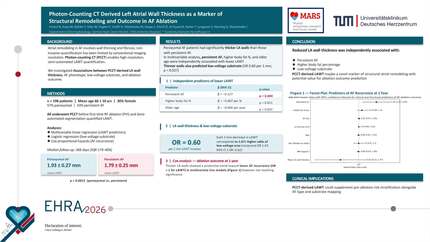
Photon-counting CT derived left atrial wall thickness as a marker of structural remodeling and outcome in AF ablation

Presentation
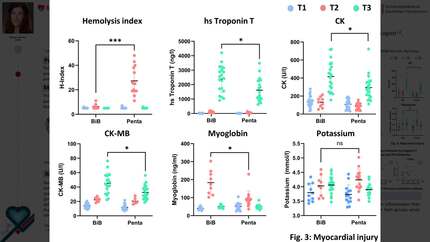
Differences in hemolysis, myocardial injury and renal safety after pulsed field ablation using a balloon-in-basket and a pentaspline catheter
Presentation
Long-term heart failure improvement after catheter ablation of persistent atrial fibrillation in heart failure with preserved, mildly reduced and reduced ejection fraction
Presentation

