Predictors of new-onset in-hospital atrial fibrillation in 122 089 patients admitted with COVID-19: an Australian statewide population study
European Heart Journal


Abstract
New-onset atrial fibrillation (AF) when encountered in COVID-19 patients may be associated with increased mortality and thromboembolic events. Few studies have investigated predictors of new-onset AF in the context of COVID-19 and no study has assessed the utility of CHA2DS2VASc score in predicting new-onset AF in COVID-19 patients.
This study aims to identify independent predictors of new-onset in-hospital AF in patients admitted with COVID-19.
Patients admitted with COVID-19 (1-Jan-2020 to 30-Sept-2021) were identified from the Admitted-Patient-Data-Collection database in an Australian state, stratified by AF status (no-AF vs new-AF during index COVID-19 admission) and followed-up until 31-Mar-2022. Patients with prior-AF were excluded from analysis. New-AF was defined as new-onset AF during the hospital admission for COVID-19. Independent predictors of new-AF were identified using multivariable logistic regression. Receiver Operating Characteristic (ROC) derived Area Under Curve (AUC) score was performed to determine the predictive power of independent predictors of new-AF.
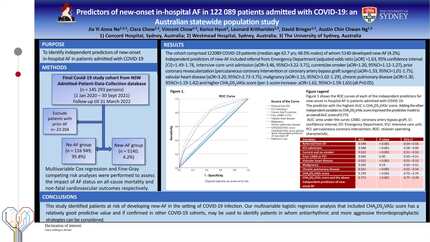
The cohort comprised 122089 COVID-19 patients (median age 62.7 yrs; 48.5% males) of whom 5140 developed new-AF (4.2%). Compared to patients with no-AF, patients with new-AF had a higher prevalence of comorbidities and cardiac risk factors (hypertension, diabetes and smoking) as well as a higher CHA2DS2VASc score (p < 0.001) (Table 1). Independent predictors of new-AF included referral from Emergency Department (adjusted odds ratio [aOR] =1.63, 95% confidence interval [CI]=1.49-1.78, intensive-care-unit admission (aOR=3.46, 95%CI=3.22-3.71), current/ex-smoker (aOR=1.20, 95%CI=1.12-1.27), prior coronary revascularization (percutaneous coronary intervention or coronary artery bypass graft surgery) (aOR=1.33, 95%CI=1.01-1.75), valvular heart disease (aOR=3.20, 95%CI=2.73-3.75), malignancy (aOR=1.15, 95%CI=1.02-1.29), chronic pulmonary disease (aOR=1.30, 95%CI=1.19-1.42) and higher CHA2DS2VASc score (per-1-score increase: aOR=1.62, 95%CI=1.59-1.65) (all P<0.05). CHA2DS2VASc score alone had an AUC score of 0.729 (95%CI=0.72-0.74) (Figure 1). Adding the above additional independent variables to CHA2DS2VASc score improved the predictive model to an overall AUC score of 0.773 (95%CI=0.77-0.78), p < 0.001.
This study identified patients at risk of developing new-AF in the setting of COVID-19 infection. Our multivariable logistic regression analysis that included CHA2DS2VASc score has a relatively good predictive value and if confirmed in other COVID-19 cohorts, may be used to identify patients in whom antiarrhythmic and more aggressive thromboprophylactic strategies can be considered.





You may be interested in