Remote monitoring of cardiac implantable electronic devices using smart device interface versus radiofrequency-based interface: a systematic review
European Heart Journal


Abstract
Guidelines recommended remote monitoring (RM) in managing patients with Cardiac Implantable Electronic Devices (CIED). In recent years, smart device (phone or tablet) monitoring-based RM (SM-RM) was introduced. SM-RM is a specifically developed application (app) which can be downloaded from app stores using smart devices. The app uses Bluetooth low-energy to communicate automatically and securely with the patient’s CIED. The app then uses a cellular or Wi-Fi internet connection to transfer the data securely to the manufacturer’s repository.
This study aims to systematically review SM-RM versus bedside monitor RM (BM-RM) using radiofrequency in terms of compliance, connectivity, and episode transmission time.
We conducted a systematic review, searching three international databases from inception until July 2023 for studies comparing SM-RM (intervention group) versus BM-RM (control group).
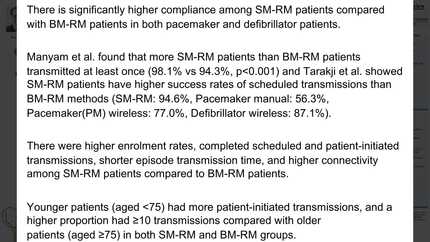
Two propensity score-matched studies with a total of 21978 patients were retrieved (9642 patients in the SM-RM arm and 12336 patients in the BM-RM arm) (1, 2). There is significantly higher compliance among patients using SM-RM compared with patients using BM-RM in both pacemaker and defibrillator patients. There were higher enrolment rates and completed scheduled transmissions among SM-RM compared to BM-RM. Higher connectivity was also seen in patients with SM-RM, and more SM-RM patients transmitted at least once compared to BM-RM patients. Additionally, SM-RM patients had more patient-initiated transmissions compared to BM-RM patients. Younger patients (aged <75) had more patient-initiated transmissions, and a higher proportion had ≥10 such transmissions compared with older patients (aged ≥75) in both SM-RM and BM-RM groups. The episode transmission time of SM-RM patients was also shorter than that of BM-RM patients.
SM-RM is a step in the right direction, with good compliance, connectivity, and shorter episode transmission time. It allows patients to feel empowered and in control of their health. Further research on cost-effectiveness and long-term clinical outcomes can be carried out in the future.


You may be interested in