Improved clinical outcome by means of three-dimensional electroanatomically- guided slow pathway elimination with irrigated, contact- force sensing catheter
European Heart Journal


Abstract
Slow pathway (SP) ablation, in the context of atrioventricular node reentrant tachycardia (AVNRT) treatment could result in either complete elimination or only modification of the SP with ambiguity regarding associated benefits.
Three-dimensional electroanatomical mapping (3D-EAM) with irrigated, contact-force sensing may be used adjunctively aiming to complete SP elimination. Our purpose was to compare a 3D-EAM based strategy targeting SP elimination to the conventional fluoroscopic approach with respect to clinical outcome.
Eighty-four consecutive AVNRT patients (33 males, mean age 50.1±11.7 years) underwent a conventional fluoroscopic ablation approach (N=42) or a 3D-EAM-guided ablation irrigated, contact-force sensing catheter (ThermoCool SmartTouch ST, Biosense Webster, Inc.) focusing on complete SP elimination (N=42).
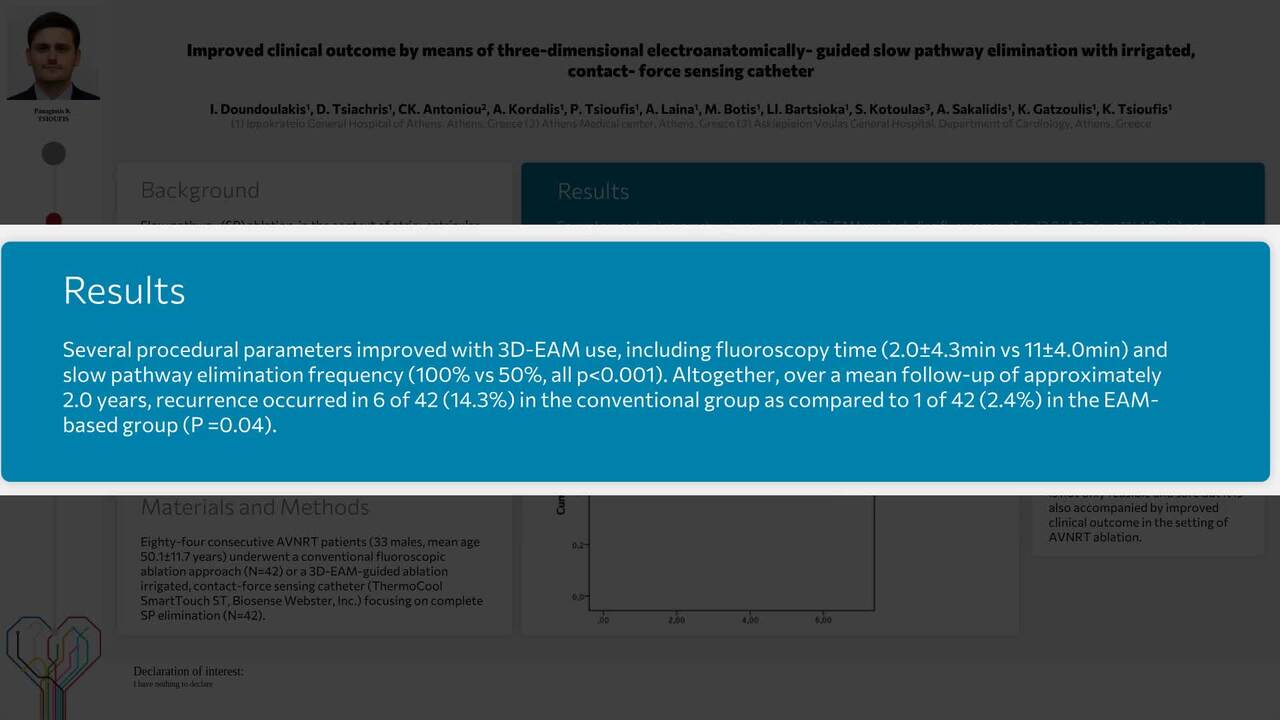
Several procedural parameters improved with 3D-EAM use, including fluoroscopy time (2.0±4.3min vs 11±4.0min) and slow pathway elimination frequency (100% vs 50%, all p<0.001). Altogether, over a mean follow-up of approximately 2.0 years, recurrence occurred in 6 of 42 (14.3%) in the conventional group as compared to 1 of 42 (2.4%) in the EAM-based group (P =0.04).
The present study showed that an EAM-based SP elimination strategy is not only feasible and safe but it is also accompanied by improved clinical outcome in the setting of AVNRT ablation.
Contributors



C K Antoniou
Author
A Kordalis
Author
P Tsioufis
Author
A Laina
Author
L I Bartsioka
Author
S Kotoulas
Author
A Sakalidis
Author
K Gatzoulis
Author
K Tsioufis
Author
You may be interested in