A meta-analysis of the safety and efficacy of pulsed-field versus conventional thermal ablation for atrial fibrillation
European Heart Journal


Abstract
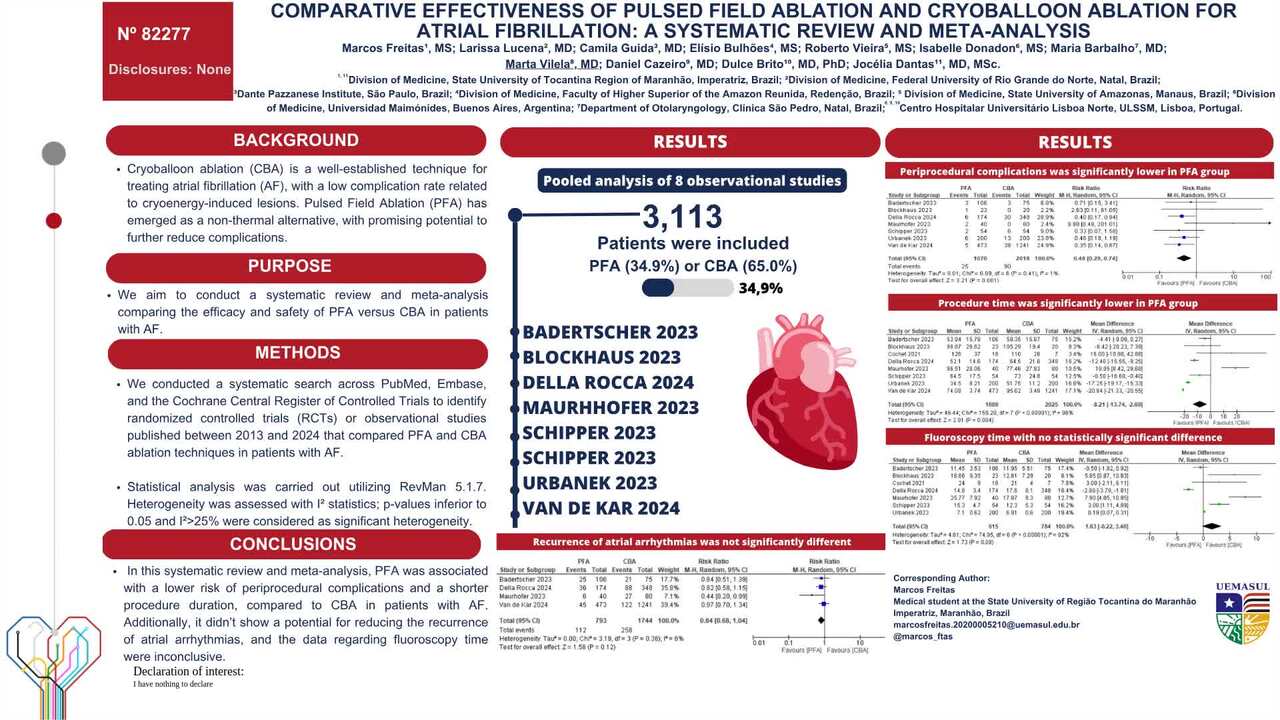
Since pulsed-field ablation (PFA) specifically targets myocardial tissue, it has become a cutting-edge substitute for radiofrequency (RF) and cryoablation.
We aim to compare the safety and efficacy of PFA vs thermal ablation for AF ablation.
We conducted a systematic review and meta-analysis synthesizing randomized controlled trials (RCTs) and observational comparative studies, which were retrieved by systematically searching: PubMed, EMBASE, Web of Science, SCOPUS, and Cochrane through September 2023. RevMan version 5.4 software was used to pool dichotomous data using risk ratio (RR) and continuous data using mean difference (MD) with a 95% confidence interval (CI).
Seventeen studies with a total of 2,255 patients were included. PFA was significantly associated with a decreased AF recurrence (RR: 0.65, 95% CI [0.51, 0.84], P= 0.0010) but not any arrhythmia recurrence (RR: 0.87, 95% CI [0.69, 1.09], P= 0.22). Also, PFA was significantly associated with decreased total procedure time (MD: -15.15, 95% CI [-20.23, -10.07], P< 0.00001) and heart rate (MD: -7.56, 95% CI [-12.78, -2.34], P= 0.005); however, there was no significant difference between PFA and thermal ablation in fluoroscopy time (MD: 2.83, 95% CI [-0.38, 6.04], P= 0.08). PFA decreased phrenic nerve palsy (RR: 0.38, 95% CI [0.15, 0.98], P= 0.05) and esophageal lesions (RR: 0.09, 95% CI [0.01, 0.69], P= 0.02); however, PFA was significantly associated with increased pericardial tamponade (RR: 6.14 with 95% CI [1.43, 26.33], P= 0.01).
PFA was significantly associated with decreased AF recurrence, heart rate, total procedure time, phrenic nerve palsy, esophageal lesion, and increased incidence of pericardial tamponade compared with thermal ablation. However, current evidence is mainly weighted by observational studies, requiring further large-scale randomized trials. Figure
Contributors


You may be interested in