Electrical risk score beyond the left ventricular ejection fraction: prediction of sudden cardiac death in the Oregon Sudden Unexpected Death Study and the Atherosclerosis Risk in Communities Study
European Heart Journal


Abstract
There is an urgent need to extend sudden cardiac death (SCD) risk stratification beyond the left ventricular ejection fraction (LVEF). We evaluated whether a cumulative electrocardiogram (ECG) risk score would improve identification of individuals at high risk of SCD.
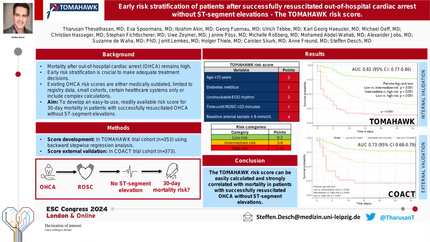
In the community-based Oregon Sudden Unexpected Death Study (catchment population ∼1 million), 522 SCD cases with archived 12-lead ECG available (65.3 ± 14.5 years, 66% male) were compared with 736 geographical controls to assess the incremental value of multiple ECG parameters in SCD prediction. Heart rate, LV hypertrophy, QRS transition zone, QRS-T angle, QTc, and Tpeak-to-Tend interval remained significant in the final model, which was externally validated in the Atherosclerosis Risk in Communities (ARIC) Study. Sixteen percent of cases and 3% of controls had ≥4 abnormal ECG markers. After adjusting for clinical factors and LVEF, increasing ECG risk score was associated with progressively greater odds of SCD. Overall, subjects with ≥4 ECG abnormalities had an odds ratio (OR) of 21.2 for SCD [95% confidence interval (CI) 9.4–47.7;
This novel cumulative ECG risk score was independently associated with SCD and was particularly effective for LVEF >35% where risk stratification is currently unavailable. These findings warrant further evaluation in prospective clinical investigations.
Contributors

Aapo L Aro
Author
Kyndaron Reinier
Author
Carmen Rusinaru
Author
Audrey Uy-Evanado
Author
Navid Darouian
Author
Derek Phan
Author
Wendy J Mack
Author
Jonathan Jui
Author
Elsayed Z Soliman
Author
Larisa G Tereshchenko
Author

You may be interested in