The impact of multimorbidity on cardiac remodelling in the UK Biobank
European Heart Journal


Abstract
Previous work has suggested that multimorbidity is associated with higher all-cause mortality and cardiovascular mortality in the UK Biobank (UKB). The impact of multimorbidity on cardiac remodelling as measured by cardiovascular magnetic resonance (CMR) has not been studied in large cohorts.
To determine if CMR biomarkers act as surrogates for adverse cardiovascular outcomes in multimorbidity.
We analysed 44957 UKB participants who had CMR. Self-reported cancer (UKB field ID 20001) and non-cancer illnesses (UKB field ID 20002) were used to calculate comorbidity count with multi-morbidity defined as 2 or more illnesses. The predictive value of comorbidity count (exposure counts measured in quintiles) on CMR traits (outcomes) was evaluated using a univariable and multivariable generalised linear model. Covariates included sex, age, BMI, smoking status, regular alcohol intake, and the Townsend deprivation index, a measure of socioeconomic deprivation. The first model utilised univariable regression without covariates with subsequent iterations including age and sex and then all covariates. An interaction term was included for age and sex and a quadratic term for age in the models. CMR outcome measures were indexed left ventricular mass (LVM), indexed left ventricular end diastolic volume (LVEDV), indexed left ventricular end systolic volume (LVESV), indexed left ventricular stroke volume (LVSV), left ventricular ejection fraction (LVEF), global longitudinal strain (GLS), and indexed maximal left atrial volume (LA). The absolute value of GLS was used in the regression models. Variance inflation factor testing was used to check for collinearity. Analyses were completed using R v4.1.1.
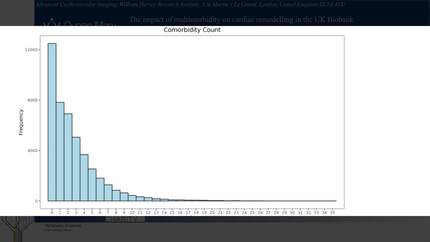
Median comorbidity count was 2. The burden of long-term conditions in this population of European ancestry with largely healthy individuals is lower than in other large population cohorts. Table 1 summarises multivariable analyses for comorbidity count, LVM and GLS. Due to high collinearity relating to age in the model, we centred age around the mean. LVM was higher with multimorbidity (top quintile Beta 0.63 (95% CI 0.23 to 1.04), P = 2.21x10-03). GLS was lower with multimorbidity (top quintile Beta -0.29 (95%CI -0.42 to 0.16), P = 8.10x10⁻⁶). LA volume was lower with multimorbidity (top quintile Beta -0.63(95% CI -1.22 to 0.04), P = 3.53 x 10⁻²). LVEF and other volume measures were not associated with multimorbidity.
Multimorbidity in this large cohort was associated with adverse cardiac structural and functional remodelling on CMR. These include a lower global longitudinal strain and higher LV mass.
Contributors

V Shyam-Sundar
Author
St Bartholomews and Queen Mary University London , United Kingdom of Great Britain & Northern Ireland

H Nicholls
Author
Queen Mary University of London London , United Kingdom of Great Britain & Northern Ireland

S Chadalavada
Author
J Vargas
Author
G Slabaugh
Author

S Mohiddin
Author
St Bartholomew's Hospital London , United Kingdom of Great Britain & Northern Ireland

S Petersen
Author
Queen Mary University of London London , United Kingdom of Great Britain & Northern Ireland

N Aung
Author
Queen Mary University of London London , United Kingdom of Great Britain & Northern Ireland
You may be interested in