Prognostic impact of the concept of late gadolinium enhancement granularity in non-ischaemic dilated cardiomyopathy
European Heart Journal


Abstract
The prognostic stratification of non-ischaemic dilated cardiomyopathy (DCM) to predict the risk of death is mainly driven by the left ventricular ejection fraction (LVEF). Indeed, LVEF<35% is currently the only indication for primary prevention with implantable cardioverter-defibrillator (ICD) in these patients. Beyond LVEF, several cardiac magnetic resonance imaging (MRI) studies have suggested the strong prgnostic impact of late gadolinium enhancement (LGE), and particularly its extent and location. Therefore, we assumed that a more granular approach combining detailed LGE findings including extent, location and pattern could improve risk stratification in this population.
To assess the additional prognostic value of the concept of "Late Gadolinium Enhancement (LGE) Granularity" that includes extent, location, and pattern in non-ischaemic dilated cardiomyopathy (DCM) patients to predict all-cause death.
Between 2008-2021, all consecutive patients with DCM without ICD or history of sustained ventricular arrythmia referred for cardiac MRI were included in two French centres. In line with the current ESC and AHA guidelines, DCM was defined by the LV dilation and LVEF< 50% using cardiac MRI. All patients with history of coronary artery disease or clinical history of myocarditis were excluded. The primary outcome was all-cause death using the French National Registry of Death. Cox regressions were performed to determine the prognostic value of each LGE findings. The additional prognostic value of the LGE granularity was assessed by the C-statistic increment, the continuous net reclassification improvement (NRI), and the integrative discrimination index (IDI).
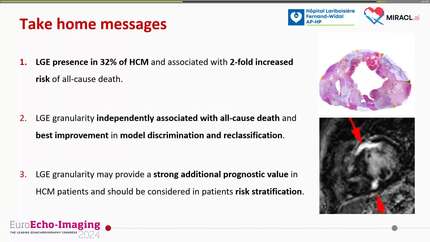
Of 1,668 DCM patients (age 52±8 years, 54% males), 268 (16%) died after a median (interquartile range) follow-up of 9 (7-12) years. With a median LVEF value of 39% (30-46), 472 (28%) patients had non-ischemic LGE. Using survival curves, patients with LVEF>35% but the LGE septal location showed a higher risk of death compared to all patients with LVEF≤35% with or without LGE (except for the septal location, all p<0.001). In DCM patients with LGE (N=472), LGE extent (adjusted HR: 4.27, 95% CI: 2.22-8.22), septal location (HR: 5.74, 95% CI: 3.35-9.85) and multiple areas of LGE (HR: 4.38, 95% CI: 2.08-9.22; all p<0.001) were all independently associated with death after adjustment for prognosticators. The concept of "LGE granularity" combining all these LGE features showed the best improvement in model discrimination and reclassification over traditional prognosticators including LVEF (C-statistic improvement: 0.14; net reclassification improvement=64.3%; integrative discrimination index=29.0%; all p<0.05).
In a large cohort of DCM patients, the concept of "LGE granularity" combining LGE extent, location and the presence of multiple areas had an additional prognostic value above traditional prognosticators including LVEF to predict all-cause death.
Contributors


J Garot
Author
S Toupin
Author
V Bousson
Author
F Sanguineti
Author
S Duhamel
Author
T Unterseeh
Author
T Hovasse
Author
A Unger
Author
J Florence
Author
A Bondue
Author
J G Dillinger
Author
P Henry
Author
P Garot
Author
T Pezel
Author
You may be interested in