Comparison between coronary calcium score and segment involvement score when used in clinical routine
European Heart Journal


Abstract
Data from a nationwide registry on coronary computer tomography angiography.
The Coronary Artery Calcium Score (CACS) and segment involvement score (SIS) are crucial factors in assessing the severity of coronary artery disease (CAD) and determining the likelihood of future cardiovascular events. However, there are few large multicenter studies comparing the predictive value of CACS and SIS when used in the clinical routine.
To compare CACS and SIS ability to predict cardiovascular outcomes when used in the clinical routine.
This retrospective cohort study included patients who underwent Coronary Computed Tomography Angiography (CCTA) for CAD evaluation between 2006-2022 in 29 different centers in Sweden. CACS was calculated using the Agatston method, and SIS was determined based on the number of coronary segments exhibiting plaque. For SIS, patients were categorized into SIS=0, SIS=1, SIS=2, SIS=3, SIS³4, for CACS patients were categorized into CACS=0, CACS=1-9, CACS=10-99, CACS=100-299, CACS³300. Patients were followed regarding the primary outcome of death or myocardial infarction. Multivariable Cox proportional hazards models were used for adjusting for potential confounders.
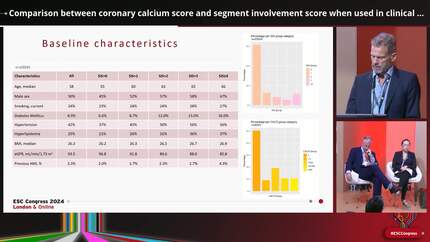
A total of 23034 patients underwent CCTA and were followed for up to ten years. Median age (IQR) was 58 (49–67) years, 50% were women, 9% had diabetes mellitus, 42% had hypertension, 25% had hyperlipidemia, 5% had previously known CAD. There were 955 patients (4.1%) with myocardial infarction (MI) and 409 patients (2.2%) died during follow up. There was an increase in cardiovascular events with increasing SIS. When comparing SIS and presence of obstructive stenosis, SIS was a better predictor of outcome (Figure 1). There was also an increase cardiovascular events with increasing CACS (Figure 2). When adjusted for age, sex, risk factors, previous cardiovascular disease and intervention, both SIS and CACS were independently associated with outcome. When SIS and CACS were compared in a receiver operating characteristic curve, CACS had significantly larger AUC than SIS, (0.70[0.67-0.73] vs 0.62[0.60-0.63]).
Our findings show that both CACS and SIS are important and independent predictors of cardiovascular outcomes thereby offering a valuable tool for personalized risk stratification and management in clinical settings. When used in the clinical routine, CACS appears to be more strongly associated with outcome than SIS. Survival SIS Survival CACS
Contributors

You may be interested in