Fully automated measurements of echocardiographic mechanical dispersion using deep learning: enhanced prediction of ventricular arrhythmias in a large heart failure cohort
European Heart Journal


Abstract
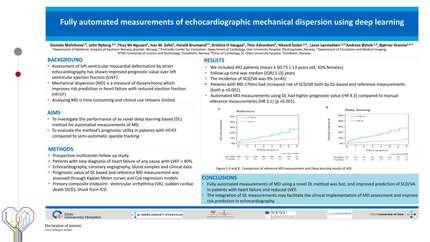
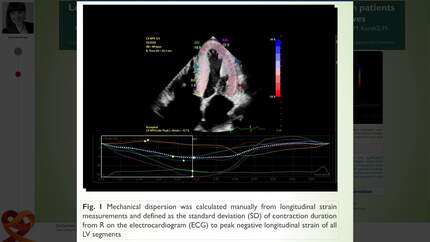
Assessment of left ventricular (LV) myocardial deformation by strain echocardiography has shown improved prognostic value over LV ejection fraction (LVEF). Mechanical dispersion (MD) by strain reflects deformation heterogeneity. Also, MD is a marker of ventricular arrhythmia (VA) that improves risk prediction independently of LVEF in patients with heart failure. However, to analyze MD is time consuming and operator-dependent, and clinical use remains limited.
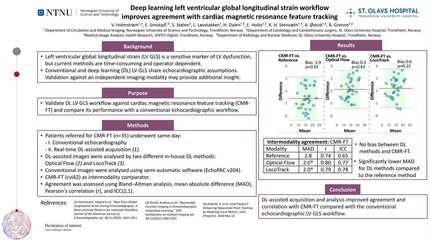
We aimed to investigate the performance of a novel deep learning (DL) based method for fully automated measurements of MD and evaluate its prognostic utility in patients with heart failure compared to a conventional speckle tracking application.
In this prospective multicenter follow up study, the IMPROVE study, we consecutively included patients with recently diagnosed heart failure of all cause with LVEF ≤ 40%. Echocardiograms, ECG, blood samples and clinical data were acquired during index hospitalization. All patients were treated according to contemporary guidelines with optimal medical therapy and revascularization if necessary. Two experienced cardiologists recorded all echocardiograms using Vivid E9 or E95 scanners. We obtained data regarding sudden cardiac death, ventricular arrhythmia and appropriate shock from the ICD from medical records and ICD recordings. The primary endpoint was sudden cardiac death or ventricular arrhythmia (SCD/VA) during follow-up. The prognostic value of DL-based and reference MD measurements was assessed through survival statistics.
We included 492 patients (mean ± SD 73 ± 13 years old, 32% females). Follow-up time was median (IQR) 5 (3) years. The incidence of SCD/VA was 9% (n=45). Patients with MD ≥70ms had increased risk of SCD/VA both by DL-based and reference measurements (both p <0.001). Furthermore, automated MD measurements using DL had higher prognostic value (HR 4.3) compared to manual reference measurements (HR 3.1) (p <0.001).
Fully automated measurements of MD using a novel DL method was fast, feasible, and improved prediction of SCD/VA in patients with heart failure and reduced LVEF. The integration of DL measurements may facilitate the clinical implementation of MD assessment and improve risk prediction in echocardiography.



You may be interested in