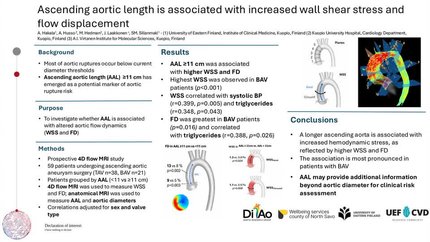
Wall shear stress measured with 4D flow CMR correlates with biomarkers of inflammation and collagen synthesis in mild-to-moderate ascending aortic dilation and tricuspid aortic valves
European Heart Journal - Cardiovascular Imaging


Abstract
Understanding the mechanisms underlying ascending aortic dilation is imperative for refined risk stratification of these patients, particularly among incidentally identified patients, most commonly presenting with tricuspid valves. The aim of this study was to explore associations between ascending aortic haemodynamics, assessed using four-dimensional flow cardiovascular magnetic resonance imaging (4D flow CMR), and circulating biomarkers in aortic dilation.
Forty-seven cases with aortic dilation (diameter ≥ 40 mm) and 50 sex-and age-matched controls (diameter < 40 mm), all with tricuspid aortic valves, underwent 4D flow CMR and venous blood sampling. Associations between flow displacement, wall shear stress (WSS), and oscillatory shear index in the ascending aorta derived from 4D flow CMR, and biomarkers including interleukin-6, collagen type I α1 chain, metalloproteinases (MMPs), and inhibitors of MMPs derived from blood plasma, were investigated. Cases with dilation exhibited lower peak systolic WSS, higher flow displacement, and higher mean oscillatory shear index compared with controls without dilation. No significant differences in biomarkers were observed between the groups. Correlations between haemodynamics and biomarkers were observed, particularly between maximum time-averaged WSS and interleukin-6 (
Significant associations were discovered between 4D flow CMR derived whole-cardiac cycle WSS and circulating biomarkers representing inflammation and collagen synthesis, suggesting an intricate interplay between haemodynamics and the processes of inflammation and collagen synthesis in patients with early aortic dilation and tricuspid aortic valves.
Contributors

Filip Hammaréus
Author
Department of Medical, Health and Caring Sciences Linkoping University (HMV) Linkoping , Sweden

Chiara Trenti
Author
Hanna M Björck
Author
Jan Engvall
Author
Hanna Lekedal
Author
David Kylhammar
Author
Marcus Lindenberger
Author
Anna K Lundberg
Author
Fredrik Nilsson
Author
Lennart Nilsson
Author

Lena Jonasson
Author

You may be interested in