Bleeding risk prediction after acute myocardial infarction-integrating cancer data: the updated PRECISE-DAPT cancer score
European Heart Journal


Abstract
This study assessed the impact of incorporating cancer as a predictor on performance of the PRECISE-DAPT score.
A nationally linked cohort of ST-elevation myocardial infarction patients between 1 January 2005 and 31 March 2019 was derived from the UK Myocardial Ischaemia National Audit Project and the UK Hospital Episode Statistics Admitted Patient Care registries. The primary outcome was major bleeding at 1 year. A new modified score was generated by adding cancer as a binary variable to the PRECISE-DAPT score using a Cox regression model and compared its performance to the original PRECISE-DAPT score.
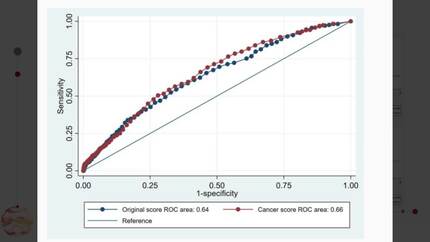
A total of 216 709 ST-elevation myocardial infarction patients were included, of which 4569 had cancer. The original score showed moderate accuracy (C-statistic .60), and the modified score showed modestly higher discrimination (C-statistics .64; hazard ratio 1.03, 95% confidence interval 1.03–1.04) even in patients without cancer (C-statistics .63; hazard ratio 1.03, 95% confidence interval 1.03–1.04). The net reclassification index was .07. The bleeding rates of the modified score risk categories (high, moderate, low, and very low bleeding risk) were 6.3%, 3.8%, 2.9%, and 2.2%, respectively. According to the original score, 65.5% of cancer patients were classified as high bleeding risk (HBR) and 21.6% were low or very low bleeding risk. According to the modified score, 94.0% of cancer patients were HBR, 6.0% were moderate bleeding risk, and no cancer patient was classified as low or very low bleeding risk.
Adding cancer to the PRECISE-DAPT score identifies the majority of patients with cancer as HBR and can improve its discrimination ability without undermining its performance in patients without cancer.
Contributors

Mohamed Dafaalla
Author
Francesco Costa
Author
Evangelos Kontopantelis
Author
Mario Araya
Author
Tim Kinnaird
Author
Antonio Micari
Author
Haibo Jia
Author
Gary S Mintz
Author

You may be interested in