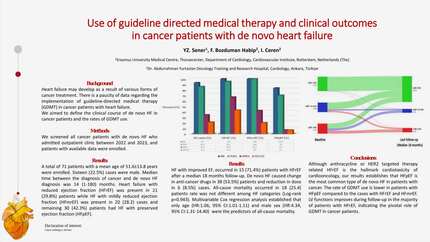
Therapy duration and improvement of ventricular function in de novo heart failure: the Heart Failure Optimization study

European Heart Journal

12 June 2024
Organised by: Logo
ESC Journals ARRHYTHMIAS AND DEVICE THERAPY HEART FAILURE Chronic Heart Failure

Abstract

AbstractBackground and Aims

In patients with de novo heart failure with reduced ejection fraction (HFrEF), improvement of left ventricular ejection fraction (LVEF) is expected to occur when started on guideline-recommended medical therapy. However, improvement may not be completed within 90 days.

Methods

Patients with HFrEF and LVEF ≤ 35% prescribed a wearable cardioverter-defibrillator between 2017 and 2022 from 68 sites were enrolled, starting with a registry phase for 3 months and followed by a study phase up to 1 year. The primary endpoints were LVEF improvement > 35% between Days 90 and 180 following guideline-recommended medical therapy initiation and the percentage of target dose reached at Days 90 and 180.

Results

A total of 598 patients with de novo HFrEF [59 years (interquartile range 51–68), 27% female] entered the study phase. During the first 180 days, a significant increase in dosage of beta-blockers, renin–angiotensin system inhibitors, and mineralocorticoid receptor antagonists was observed (P < .001). At Day 90, 46% [95% confidence interval (CI) 41%–50%] of study phase patients had LVEF improvement > 35%; 46% (95% CI 40%–52%) of those with persistently low LVEF at Day 90 had LVEF improvement > 35% by Day 180, increasing the total rate of improvement > 35% to 68% (95% CI 63%–72%). In 392 patients followed for 360 days, improvement > 35% was observed in 77% (95% CI 72%–81%) of the patients. Until Day 90, sustained ventricular tachyarrhythmias were observed in 24 wearable cardioverter-defibrillator carriers (1.8%). After 90 days, no sustained ventricular tachyarrhythmia occurred in wearable cardioverter-defibrillator carriers.

Conclusions

Continuous optimization of guideline-recommended medical therapy for at least 180 days in HFrEF is associated with additional LVEF improvement > 35%, allowing for better decision-making regarding preventive implantable cardioverter-defibrillator therapy.

Contributors

Christian Veltmann
Christian Veltmann

Author

Heart Center Bremen Bremen , Germany

David Duncker
David Duncker

Author

Hannover Heart Rhythm Center Hannover , Germany

Johann Bauersachs
Johann Bauersachs

Author

Hannover Medical School Hannover , Germany

Lars S Maier
Lars S Maier

Author

University Hospital Regensburg Regensburg , Germany