Quantitative myocardial blood flow and long-term outcome benefit from revascularization
European Heart Journal - Cardiovascular Imaging


Abstract
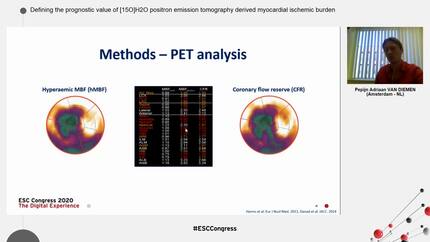
There is controversy regarding the outcome benefit from myocardial revascularization in patients with chronic coronary artery disease (CAD). We hypothesized that severely reduced regional stress myocardial blood flow (MBF) quantified by [15O]H2O positron emission tomography (PET) is associated with prognostic benefit from early revascularization.
To study the interaction of regional stress MBF in absolute terms and early myocardial revascularization in predicting long-term clinical outcome in chronic CAD.
From pooled cohort of two academic medical centers, we identified consecutive symptomatic patients who underwent [15O]H2O PET myocardial perfusion imaging for evaluation of CAD. The lowest regional stress MBF (ml/g/min) was calculated as an average of two adjacent segments with the lowest MBF. Early revascularization was defined as percutaneous coronary intervention (PCI) or coronary artery bypass graft surgery (CABG) within 3 or 6 months after MPI (depending on the institution). Statistical interaction between stress MBF and revascularization in predicting composite endpoint of all-cause mortality, myocardial infarction (MI), and unstable angina pectoris (UAP) was analyzed by Cox regression. Hazard ratio (HR) for early revascularization was visualized across MBF values with the use of spline function.
Out of 1600 patients (age 62 ± 9 years, 54% male), 318 (20%) underwent early revascularization (240 PCI and 78 CABG) and 228 (14%) experienced the composite endpoint during median follow-up of 7.0 years (25th–75th percentiles: 4.9–8.6 years). The cumulative incidence of the composite endpoint was higher in revascularized than non-revascularized patients (18% vs. 13%, p=0.036). There was a significant interaction (p=0.042) between the lowest regional stress MBF (adjusted HR 1.71 (95%CI 1.43-2.04) per 1 ml/g/min decrease, p<0.001) and effect of early revascularization (adjusted HR 0.44 (95%CI 0.21-0.93), p=0.032) on the incidence of the composite endpoint. In terms of long-term outcome, the effect of early revascularization was indifferent (i.e., HR=1) when the lowest regional MBF was approximately 2.0 ml/g/min (Figure). When the lowest regional stress MBF was less than 2.0 ml/g/min, early revascularization was associated with reduced long-term risk of the composite endpoint (HR<1).
In chronic CAD, early myocardial revascularization was associated with improved outcome among patients with the lowest regional stress MBF below a cut-off value of 2.0 ml/g/min by [15O]H2O PET. Quantitative severity of regional myocardial ischemia shows promise in identification of patients who gain prognostic benefit from revascularization.
Contributors



P Van Diemen
Author
P G Raijmakers
Author
R Sprengers
Author

P Knaapen
Author
J Knuuti
Author
A Saraste
Author
You may be interested in