Volumetric quantification of epicardial fat using semiautomated atrial CT segmentation in patients with atrial fibrillation: the Prospective AFAT study
EP Europace Journal


Abstract
Epicardial fat or epicardial adipose tissue (EAT) is most commonly defined as adipose tissue between the myocardium and the visceral pericardium. Previous studies have suggested EAT to be an important contributor to the pathogenesis of atrial fibrillation (AF) as well as a plausible predictor for AF recurrences after ablation. However, data on EAT using precise volumetric quantification is limited.
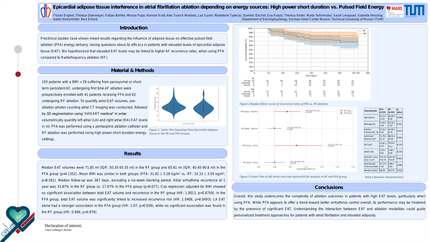
AFAT is a prospective observational study conducted at a heart centre in our city with 200 patients aimed to be included. We conducted an interim analysis of the first 75 patients enrolled in the AFAT study. All patients received delayed dual source cardiac computer tomography (CT) imaging which was analysed using semi-automated 3D segmentation (Figure 2) to quantify left atrial (LA) and right atrial (RA) EAT prior to ablation (52.5 % persistent AF). The mean age was 67 ± 8.7 years with 46.9 % (n=35) being female. Mean BMI was 28 ± 4.5. The Mean LA EAT was 33.1 ml ± 13.2 ml and RA EAT was 32.7 ml ± 12.2ml.
Median follow up after AF catheter ablation was 163 days. The optimal cut point for the total atrial EAT was estimated at 50.2 ml. In patients with total atrial EAT ≤ 50 ml recurrence of any atrial arrythmia after catheter ablation occurred in 8% (6 patients) compared to 25.3% (19 patients) recurrence rates in patients with a total atrial EAT > 50 ml. Kaplan-Meyer estimates showed no statistical difference between groups (log rank p=0.063) as this analysis is under-powered with more patients being enrolled for the final results (Figure 1).
The use of semi-automated CT based atrial segmentation presents a novel highly accurate and reproducible method to reliably identify atrial EAT. Increased atrial EAT is likely to play an important role for arrythmia recurrences after catheter ablation. Final results of the AFAT study will provide further evidence to this important subject. Arrhythmia recurrences depending on EAT Biatrial 3D Segmentation of EAT
Contributors


S Prommersberger
Author
B Neuner
Author
F Bahlke
Author

H Krafft
Author
E Abdiu
Author
T Reents
Author
C Lennerz
Author
M Telishevska
Author
S Lengauer
Author


F Bourier
Author
You may be interested in