Preliminary implantation experience in Europe with a novel insertable cardiac monitor
EP Europace Journal


Abstract
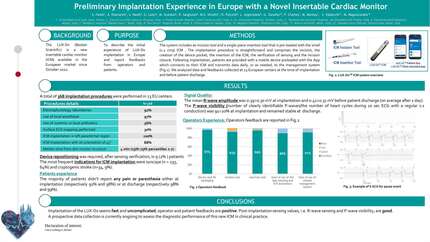
The LUX-Dx is a new insertable cardiac monitor (ICM) available in the European market since October 2022.
To describe the initial experience of LUX-Dx implantation in Europe and report feedbacks from operators and patients.
The system includes an incision tool and a single-piece insertion tool that is pre-loaded with the small (1.2 cm3) ICM. The implantation procedure is straightforward and comprises the incision, the creation of the device pocket, the insertion of the ICM, the verification of sensing and the incision closure. Following implantation, patients are provided with a mobile device preloaded with the App which connects to their ICM and transmits data daily, or as needed, to the management system. We analyzed data and feedbacks collected at 20 European centers at the time of implantation and before patient discharge.
A total of 175 implantation procedures were performed in 20 European centers. The most frequent indications for ICM implantation were syncope (n = 119, 68%) and cryptogenic stroke (n=15, 9%). Most procedures (157, 90%) were performed in electrophysiology laboratories by expert operators. The procedure was performed under local anesthesia in 169 (97%) patients, and systemic or local antibiotics were used before the procedure in 96 (55%) cases. A surface ECG mapping was performed before 65 (37%) insertions. All ICMs were implanted in the left parasternal region, with an orientation of 45° in 159 (91%) patients. Device repositioning was required after verification of sensing in 6 (3%) patients. The ICM was successfully implanted in all patients and no procedural complications were reported; the median time from skin incision to suture was 4 min (25th-75th percentiles 2-7). The mean R-wave amplitude was 0.38±0.34 mV at implantation and 0.42±0.38 mV before patient discharge (on average after 1 day). The P-wave visibility, i.e., the ratio between the number of clearly identifiable P-waves and the number of heart cycles during 10 sec ECG with a regular 1:1 conduction, was 92±21% at implantation and 93±18% before discharge. Survey questions on the overall operator experience with the implantation procedure are reported in Figure 1 and those on the patient experience are reported in Figure 2.
Implantation of the LUX-Dx seems fast and uncomplicated; operator and patient feedbacks are positive. Post-implantation sensing values, i.e. R-wave sensing and P-wave visibility, are good.
Contributors

A Diamante
Author
S Nardi
Author
G Luzzi
Author
M S Silvetti
Author
D Porcelli
Author
L Argenziano
Author
G Zanotto
Author
P Charles
Author
M Montoy
Author
M Magnocavallo
Author
You may be interested in