Adherence to remote monitoring recommendations in current clinical practice: data from a remote monitoring database
EP Europace Journal


Abstract
The recently published Expert Consensus Statement on the Practical Management of Remote Device Clinic offers evidence-based recommendations for managing patients with cardiovascular implantable electronic devices (CIEDs).
We examined data from a remote monitoring (RM) database to evaluate adherence to RM recommendations in current clinical practice.
According to RM guidelines, patients should be enrolled within 2 weeks of implantation for earlier detection of actionable events, and in any case, within 3 months, as it is associated with improved survival. Continuous connectivity should be maintained. In patients with continuous connectivity, alert-based RM may replace structured intermittent device follow-up. We analyzed data from 4427 CIED patients followed on the LATITUDE (Boston Scientific) remote network at 20 Italian centers. Patients were enrolled between 2010 and 2023, with a median RM duration of 37 months (25th-75th percentile: 21-60).
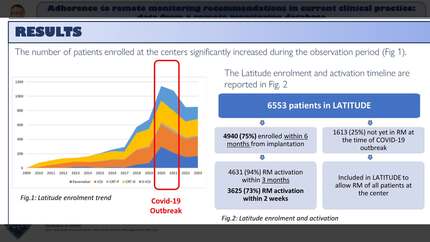
The number of patients enrolled at the centers significantly increased during the observation period (Figure). In the overall RM population, we identified a group of patients (56%) enrolled after implantation (within 6 months) and a group of patients enrolled late during their follow-up. In the first group, RM receiver activation occurred within 2 weeks in 62% and within 3 months in 90% of patients. The second group consisted mainly of patients not yet in RM at the time of COVID-19 outbreak and included to allow RM of all patients at the centers. Overall, 96% of enrolled patients performed remote data transmissions during the observation period. As of the July 2023 data extraction, 1405 (33%) patients were not monitored, with no significant differences among CIED types (CRT-D: 37%; ICD: 32%; S-ICD: 32; Pacemaker: 30%). Most not-monitored patients (30%) had not transmitted data for over a year, likely due to patient death, CIED extraction, or other irreversible causes. For the remaining 3%, the recent loss of connection (occurring within a timeframe shorter than the scheduled transmission interval) should have prompted interventions to restore connection. Scheduled device transmissions occurred at least once every 3 months in 94% of patients. Considering individual device programming, the 2836 patients with consistent connectivity performed 25,281 scheduled transmissions in one year.
In current clinical practice, RM adoption is continually increasing, with generally observed adherence to post-implantation patient enrollment recommendations. However, a significant proportion of patients may activate RM earlier. Centers must implement solutions to ensure transmission continuity in a substantial percentage of patients. Nevertheless, the workload generated by this activity could be effectively balanced by adopting an alert-based RM strategy and reducing unnecessary scheduled transmissions. Enrolled patients trend
Contributors


M Giammaria
Author
D Pecora
Author
A Salucci
Author
V E Santobuono
Author
F Adamo
Author
P Pepi
Author
M Viscusi
Author


You may be interested in