Impact of photoplethysmography-based smartphone rhythm monitoring on atrial fibrillation detection and management after cardiac surgery: a pragmatic randomized trial
EP Europace Journal


Abstract
Postoperative atrial fibrillation (POAF) occurring after cardiac surgery is common and associated with adverse outcomes. Systematic monitoring of POAF beyond discharge is cumbersome. The emergence of photoplethysmography (PPG)-based rhythm monitoring with digital consumer devices could potentially mitigate these hurdles. Selected smartphone applications leveraging this technology have demonstrated excellent usability and accuracy for the detection of atrial fibrillation (AF). However, the impact of PPG-detected POAF on real-life clinical practice remains uncertain.
To determine whether intermittent PPG-based smartphone rhythm monitoring, after being discharged home following cardiac surgery, impacts AF management.
The SURGICAL-AF 2 study is a pragmatic, investigator-initiated, open-label, multicenter, randomized clinical trial, conducted in three Belgian centers. The intervention group performed one-minute rhythm checks three times daily with a smartphone-based PPG application after hospitalization for cardiac surgery until the first follow-up visit with a cardiologist, scheduled at 21 – 91 days. Rhythm monitoring was not mandated in the usual care group. The primary endpoint was a composite of initiation of oral anticoagulation (OAC), cardioversion, up-titration or initiation of antiarrhythmic drugs (Vaughan-Williams class I or III) or implantation of a cardiac implantable electronic device (CIED). Secondary endpoints were incidence of POAF and actionable POAF, defined as a detection in patients with CHA2DS2-VASc score ≥2 for women or ≥1 for men who are not treated with OAC.
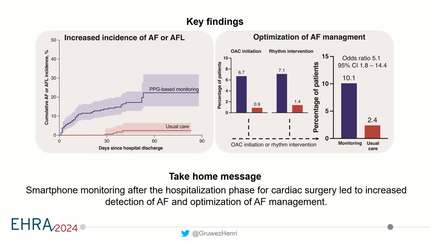
Of the 450 patients randomized (238 patients in the intervention group and 212 patients in the usual care group; mean [SD] age, 64.1 [9.2] years; 96 women [21.3%]; 130 patients with AF before inclusion [28.9%]; 103 patients on OAC [22.9%], median [interquartile range] CHA2DS2-VASc score, 2 [1-3]), 98.7% completed the trial. In the intent-to-treat analysis, the primary end point occurred in 24 patients (10.3%) in the intervention group versus 5 patients (2.4%) in the usual care group (odds ratio (OR) 4.7, 95% CI, 1.8 - 12.6; P =.002). POAF was detected in 44 patients (18.8%) in the intervention group and was actionable in 25 patients (10.7%) versus 4 patients (1.9%) in the usual care group and actionable in 2 patients (0.9%). (POAF detection, OR 12.0, 95% CI, 4.2 - 34.5; P < .001; actionable POAF, OR 12.5, 95% CI, 2.9 - 52.6; P < .001)
In unselected patients discharged home following cardiac surgery, PPG-based smartphone monitoring revealed significantly more POAF which led to changes in AF management (OAC initiation, rhythm control therapy or CIED insertion). Longer follow-up is needed to determine whether these changes will lead to improved outcomes.
Contributors


N De Melio
Author
P Vermunicht
Author
L Van Langenhoven
Author
M Lamberigts
Author
I Rodrigus
Author
C Van Kerrebroeck
Author
P Vandervoort
Author
H Heidbuchel
Author
P Pison
Author
You may be interested in