Hybrid ablation versus repeated catheter ablation in persistent atrial fibrillation: long-term results of the HARTCAP-AF trial
EP Europace Journal


Abstract
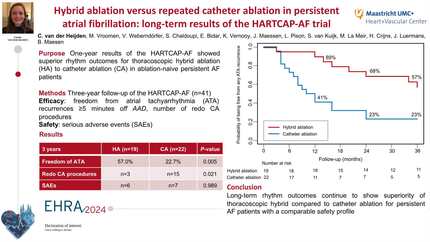
The HARTCAP-AF study compared the efficacy and safety outcomes in forty-one ablation-naive patients with persistent atrial fibrillation (AF) randomized to thoracoscopic hybrid ablation (HA) or stand-alone catheter ablation (CA). One-year results have shown that thoracoscopic HA has superior rhythm outcomes than CA, without increasing complications.
Here, we evaluated the efficacy, safety and quality of life (QOL) of thoracoscopic HA and CA within a long-term follow-up (FU) duration of three years.
Efficacy outcomes included freedom from atrial tachyarrhythmia (ATA) recurrences ≥5 minutes off and allowing antiarrhythmic drugs (AAD) after 24 and 36 months. Safety outcomes, including serious adverse events (SAEs), and QOL, measured by the EHRA AF symptom score, were evaluated after 36 months.
After a mean FU duration of 25±3 and 38±3 months, freedom from ATA recurrences was higher in the HA group compared to the CA group off AAD (68.4% vs. 22.7%, P=0.002 and 57.0% vs. 22.7%, P=0.005) and allowing AAD (73.7% vs. 22.7%, P=0.001 and 63.2% vs. 22.7%, P=0.001) (Figure 1, Table 1). The number of redo catheter procedures was higher in the CA arm than the HA arm (n=15 vs. n=3, P=0.021). The total number of SAEs was low and did not differ between groups (HA: n=6 vs. CA: n=7, P=0.989). Moreover, QOL measured by the EHRA AF-symptom score improved for both groups post-procedure (3.2±0.7 and 1.6±0.78, P<0.001) and were better for HA than CA after 3 years (1.3±0.7 and 1.9±0.8, P=0.029).
After three years, (thoracoscopic) HA continues to have superior rhythm outcomes compared to CA with a comparable long-term safety profile. While both procedures resulted in a reduction in AF symptoms, EHRA scores were more favorably scored by patients in the HA arm. Therefore, in experienced centers thoracoscopic HA should be considered as a first-line treatment to percutaneous approaches for ablation-naive patients with persistent AF.
Contributors

C A J Van Der Heijden
Author
Maastricht University Medical Centre (MUMC) Maastricht , Netherlands (The)

M Vroomen
Author
C V Weberndorfer
Author
J G L M Luermans
Author
S M Chaldoupi
Author
E Bidar
Author

S M J Van Kuijk
Author


H J G M Crijns
Author
Cardiovascular Research Institute Maastricht (CARIM) Maastricht , Netherlands (The)
B A E Maesen
Author
You may be interested in