Association of brain infarcts and cardiac autonomic dysfunction using entropy functions in patients with atrial fibrillation
EP Europace Journal


Abstract
Cardiac autonomic dysfunction after brain infarcts is a strong predictor of adverse outcome.
The aim of this study was to investigate the association of large cortical or non-cortical brain infarcts (LNCCI) with multiscale (MSE) and sample entropy (SE), which characterize the complexity of RR interval time series in atrial fibrillation patients.
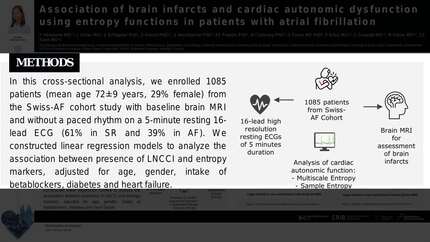
In this cross-sectional analysis, we enrolled 1085 patients (mean age 72±9 years, 29% female) from the Swiss-AF cohort study with baseline brain MRI and without a paced rhythm on a 5-minute resting 12-lead ECG (61% in SR and 39% in AF). We constructed linear regression models to analyze the association between presence of LNCCI and entropy markers, adjusted for age, gender, intake of betablockers, diabetes and heart failure.
On brain MRI, LNCCI were present in 220 patients (20.3%). 53% of these brain infarcts were clinically silent. Patients with LNCCI had a higher MSE (median 11.4 (IQR 6.5-13.3) vs. 8.5 (IQR 5.2-12.6), p<0.001) and SE (median 2.6 (IQR 1.0-3.4) vs. 1.6 (IQR 0.8-3.2), p<0.001) compared to patients without LNCCI. After adjustment for possible confounders, the presence of LNCCI was independently associated with a higher MSE (β=0.77; 95% CI 0.19-1.35, p=0.010). This association persisted when patients with a history of stroke/TIA were excluded.
Brain infarcts, irrespective if clinically overt or silent, are associated with higher entropy markers in AF patients, which indicates cardiac autonomic disturbances.
Contributors




You may be interested in