The Kir2.1E299V mutation increases atrial fibrillation vulnerability while protecting the ventricles against arrhythmias in a mouse model of short QT syndrome type 3

Cardiovascular Research

23 January 2024
Organised by: Logo
ESC Journals ARRHYTHMIAS AND DEVICE THERAPY Arrhythmias, General BASIC SCIENCE

Abstract

AbstractAims

Short QT syndrome type 3 (SQTS3) is a rare arrhythmogenic disease caused by gain-of-function mutations in KCNJ2, the gene coding the inward rectifier potassium channel Kir2.1. We used a multidisciplinary approach and investigated arrhythmogenic mechanisms in an in-vivo model of de-novo mutation Kir2.1E299V identified in a patient presenting an extremely abbreviated QT interval and paroxysmal atrial fibrillation.

Methods and results

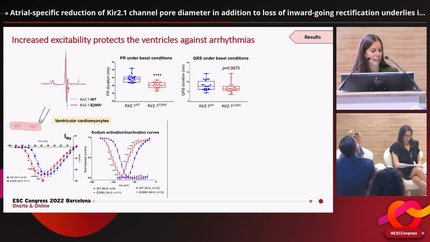
We used intravenous adeno-associated virus-mediated gene transfer to generate mouse models, and confirmed cardiac-specific expression of Kir2.1WT or Kir2.1E299V. On ECG, the Kir2.1E299V mouse recapitulated the QT interval shortening and the atrial-specific arrhythmia of the patient. The PR interval was also significantly shorter in Kir2.1E299V mice. Patch-clamping showed extremely abbreviated action potentials in both atrial and ventricular Kir2.1E299V cardiomyocytes due to a lack of inward-going rectification and increased IK1 at voltages positive to −80 mV. Relative to Kir2.1WT, atrial Kir2.1E299V cardiomyocytes had a significantly reduced slope conductance at voltages negative to −80 mV. After confirming a higher proportion of heterotetrameric Kir2.x channels containing Kir2.2 subunits in the atria, in-silico 3D simulations predicted an atrial-specific impairment of polyamine block and reduced pore diameter in the Kir2.1E299V-Kir2.2WT channel. In ventricular cardiomyocytes, the mutation increased excitability by shifting INa activation and inactivation in the hyperpolarizing direction, which protected the ventricle against arrhythmia. Moreover, Purkinje myocytes from Kir2.1E299V mice manifested substantially higher INa density than Kir2.1WT, explaining the abbreviation in the PR interval.

Conclusion

The first in-vivo mouse model of cardiac-specific SQTS3 recapitulates the electrophysiological phenotype of a patient with the Kir2.1E299V mutation. Kir2.1E299V eliminates rectification in both cardiac chambers but protects against ventricular arrhythmias by increasing excitability in both Purkinje-fiber network and ventricles. Consequently, the predominant arrhythmias are supraventricular likely due to the lack of inward rectification and atrial-specific reduced pore diameter of the Kir2.1E299V-Kir2.2WT heterotetramer.

Contributors

Ana I Moreno-Manuel
Ana I Moreno-Manuel

Author

Weizmann Institute of Science Rehovot , Israel

Álvaro Macías
Álvaro Macías

Author

National Centre for Cardiovascular Research (CNIC) Madrid , Spain

Francisco M Cruz
Francisco M Cruz

Author

Spanish National Centre for Cardiovascular Research Madrid , Spain

José Jalife
José Jalife

Author

National Centre for Cardiovascular Research (CNIC) Madrid , Spain

ESC 365 is supported by