Optimizing transseptal puncture guided by three-dimensional mapping: the role of a unipolar electrogram in a needle tip
EP Europace Journal


Abstract
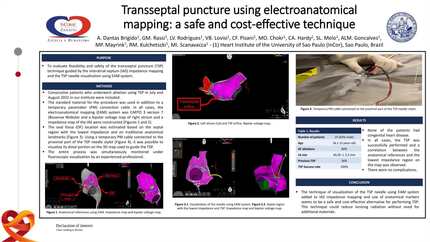
A three-dimensional electroanatomic mapping system–guided transseptal puncture (3D-TSP), without fluoroscopy or echocardiography, has been only minimally reported. Indications for 3D-TSP remain unclear. Against this background, this study aims to establish a precise technique and create a workflow for validating and selecting eligible patients for fluoroless 3D-TSP.
We developed a new methodology for 3D-TSP based on a unipolar electrogram derived from a transseptal needle tip (UEGM tip) in 102 patients (the derivation cohort) with intracardiac echocardiography (ICE) from March 2018 to February 2019. The apparent current of injury (COI) was recorded at the muscular limbus of the foramen ovalis (FO) on the UEGM tip (sinus rhythm: 2.57 ± 0.95 mV, atrial fibrillation: 1.92 ± 0.77 mV), which then disappeared or significantly reduced at the central FO. Changes in the COI, serving as a major criterion to establish a 3D-TSP workflow, proved to be the most valuable indicator for identifying the FO in 99% (101/102) of patients compared with three previous techniques (three minor criteria) of reduction in atrial unipolar or bipolar potential and FO protrusion. A total of 99.9% (1042/1043) patients in the validation cohort underwent successful 3D-TSP through the workflow from March 2019 to July 2023. Intracardiac echocardiography guidance was required for 6.6% (69/1042) of patients. All four criteria were met in 740 patients, resulting in a 100% pure fluoroless 3D-TSP success rate.
In most patients, fluoroless 3D-TSP was successfully achieved using changes in the COI on the UEGM tip. Patients who met all four criteria were considered suitable for 3D-TSP, while those who met none required ICE guidance.
Contributors

Yifan Chen
Author
Xiaoyan Wu
Author
Mengting Yang
Author
Zhibin Li
Author
Ruya Zhou
Author
Weiqian Lin
Author
Cheng Zheng
Author
Youdong Hu
Author
Jin Li
Author
Yuechun Li
Author
Jiafeng Lin
Author

Mark M Gallagher
Author
St George's University Hospital NHS Foundation Trust London , United Kingdom of Great Britain & Northern Ireland
Jia Li
Author
You may be interested in