Cryocure-VT: the safety and effectiveness of ultra-low-temperature cryoablation of monomorphic ventricular tachycardia in patients with ischaemic and non-ischaemic cardiomyopathies

EP Europace Journal

7 April 2024
Organised by: Logo
ESC Journals ARRHYTHMIAS AND DEVICE THERAPY

Abstract

AbstractAims

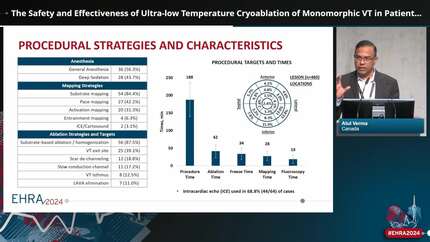
The ultra-low-temperature cryoablation (ULTC) ablation system using −196°C N2 cryogen has been reported to create lesions with freeze duration–dependent depth titratable to over 10 mm with minimum attenuation by scar. Cryocure-VT (NCT04893317) was a first-in-human clinical trial evaluating the safety and efficacy of a novel, purpose-built ULTC catheter in endocardial ablation of scar-dependent ventricular tachycardias (VTs).

Methods and results

This prospective, multi-centre study enrolled patients referred for de novo or second ablations of recurrent monomorphic VT of both ischaemic and non-ischaemic aetiologies. Primary safety and efficacy endpoints of the study were freedom from device- or procedure-related major adverse events (MAEs) up to 30 days post-ablation, acute non-inducibility of clinical VTs at the end of the procedure, and freedom from sustained VT or implantable defibrillator intervention at 6 months. Ultra-low-temperature cryoablation was performed in 64 patients (age 67 ± 11 years, 78% ischaemic, ejection fraction = 35 ± 10%) at 9 centres. The primary acute effectiveness endpoint was achieved in 94% (51/54) of patients in whom post-ablation induction was attempted. There were no protocol-defined MAEs; four procedure-related serious adverse events resolved without clinical sequelae. At 6-month follow-up, 38 patients (60.3%) remained VT-free, and freedom from defibrillator shock was 81.0%, with no significant difference between ischaemic and non-ischaemic cohorts. In 47 patients with defibrillator for at least 6 months prior to the ablation, the VT burden was reduced from median of 4, inter-quartile range (IQR, 1–9) to 0, IQR (0–2).

Conclusion

In this first-in-human multi-centre experience, endocardial ULTC ablation of monomorphic VT appears safe and effective in patients with both ischaemic-cardiomyopathy and non-ischaemic-cardiomyopathy.

Clinical Trial Registration

NCT04893317.

Contributors

Atul Verma
Atul Verma

Author

McGill University Health Centre Montreal , Canada

Katia Dyrda
Katia Dyrda

Author

Montreal Heart Institute Montreal , Canada

Arash Arya
Arash Arya

Author

Medical Faculty of Martin-Luther University Halle (Saale) Halle , Germany

Tom De Potter
Tom De Potter

Author

Cardiovascular Research Center Aalst Aalst , Belgium