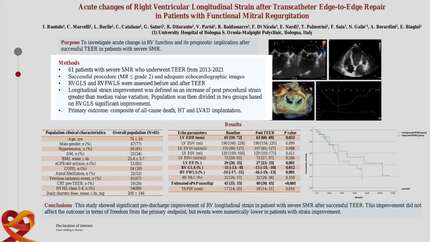
Prognostic value of right ventricular longitudinal strain in patients with secondary mitral regurgitation undergoing transcatheter edge-to-edge mitral valve repair
European Heart Journal - Cardiovascular Imaging


Abstract
To evaluate the prognostic impact of pre-procedural right ventricular longitudinal strain (RVLS) in patients with secondary mitral regurgitation (SMR) undergoing transcatheter edge-to-edge repair (TEER) in comparison with conventional echocardiographic parameters of RV function.
This is a retrospective study including 142 patients with SMR undergoing TEER at two Italian centres. At 1-year follow-up 45 patients reached the composite endpoint of all-cause death or heart failure hospitalization. The best cut-off value of RV free-wall longitudinal strain (RVFWLS) to predict outcome was −18% [sensitivity 72%, specificity of 71%, area under curve (AUC) 0.78,
RVLS is a useful and reliable tool to identify patients with SMR undergoing TEER at high risk of mortality and HF hospitalization, on top of other clinical and echocardiographic parameters, with RVFWLS offering the best prognostic performance.
Contributors


Leonardo Italia
Author

Edoardo Pancaldi
Author
Francesco Ancona
Author
Stefano Stella
Author
Elisa Pezzola
Author

Nicola Saccani
Author
Giacomo Ingallina
Author
Davide Margonato
Author
Riccardo Maria Inciardi
Author
Carlo Mario Lombardi
Author

Eustachio Agricola
Author


You may be interested in