Occlusion of the infarct-related coronary artery presenting as acute coronary syndrome with and without ST-elevation: impact of inflammation and outcomes in a real-world prospective cohort
European Heart Journal - Quality of Care and Clinical Outcomes


Abstract
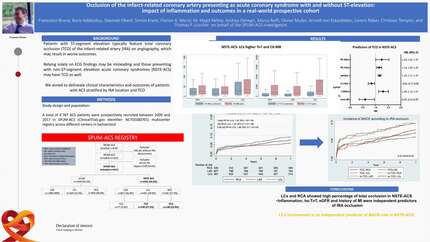
Patients with ST-segment elevation typically feature total coronary occlusion (TCO) of the infarct-related artery (IRA) on angiography, which may result in worse outcomes. Yet, relying solely on electrocardiogram (ECG) findings may be misleading and those presenting with non-ST-segment elevation acute coronary syndromes (NSTE-ACSs) may have TCO as well. Herein, we aimed to delineate clinical characteristics and outcomes of patients with ACS stratified by IRA location.
A total of 4787 ACS patients were prospectively recruited between 2009 and 2017 in SPUM-ACS (
A total of 4412 ACS patients were included in this analysis, 56.0% (
In NSTE-ACS, both LCx and RCA involvement was associated with TCO at angiography despite the absence of ST-segment elevation. Involvement of the LCx, but not the LAD or RCA, as the IRA represented an independent predictor of MACE during 1-year follow-up. Hs-CRP, lymphocyte, and neutrophil counts were independent predictors of total IRA occlusion, suggesting a possible role of systemic inflammation in the detection of TCO irrespective of ECG presentation.
Contributors


Boris Adjibodou
Author
Slayman Obeid
Author


M Majid Akhtar
Author
Andrea Denegri
Author

Olivier Muller
Author
Arnold von Eckardstein
Author
Lorenz Räber
Author
Christian Templin
Author

Thomas F Lüscher
Author
Royal Brompton and Harefield NHS Foundation Trust London , United Kingdom of Great Britain & Northern Ireland
You may be interested in