Both LBBP and LVSP significantly improve ventricular dyssynchrony and effectivity of LV performance compared to RV apical pacing in heart failure patients with LBBB and an indication to CRT
EP Europace Journal


Abstract
Type of funding sources: Public grant(s) – EU funding. Main funding source(s): Supported by the Ministry of Health of the Czech Republic, grant number NU21-02-00584 and by the project National Institute for Research of Metabolic and Cardiovascular Diseases (Programme EXCELES, ID Project No. LX22NPO5104) - Funded by the European Union – Next Generation EU.
Left bundle branch pacing and left septal myocardial pacing (LVSP) are novel methods of CRT in patients with heart failure. However, their exact impact on ventricular synchrony visualized by noninvasive assessment and the LV performance effectivity is unknown.
To compare ventricular synchrony and a change in blood pressure values between nonselective left bundle branch pacing (nsLBBP), LVSP, and RV apical pacing (RVAP) in heart failure patients.
In patients with CRT indication and LBBB, a lead was placed in the left septal area, where the transition between nsLBBP and LVSP was observed during decremental output pacing. Another lead was placed in the RV apex. UHF-ECG was used to assess ventricular synchrony during RVAP, nsLBBP, and LVSP. Dyssynchrony parameter e-DYS was calculated as an absolute value of the time difference between the first and last activation. Systolic blood pressure measurements were obtained invasively from the radial artery during VVI pacing at rates ten beats/minute higher than spontaneous rhythm. The protocol included multiple transitions between RVAP, nsLBBP, and LVSP.
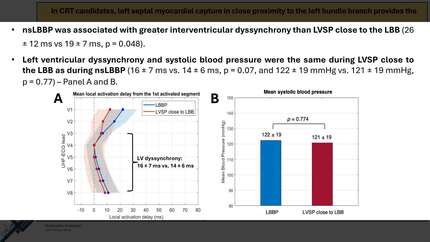
The study protocol was finalized in six patients; mean age 67 years, LVEF 33%, 3 had ischemic cardiomyopathy, and QRSd during spontaneous LBBB was 172±8 ms. QRSd was prolonged to 182±10ms during RVAP and shortened to 145±12 ms and 149±13 ms during nsLBBP and LVSP, respectively. The dyssynchrony parameter e-DYS shortened from 46±18 ms during RVAP to 1±16 ms during nsLBBP and 12±13 ms during LVSP, p < 0.05 for RVAP vs. nsLBBP and LVSP, and p = 0.4 for nsLBBP vs. LVSP. Both nsLBBP and LVSP led to a significant increase in the systolic blood pressure compared to RVAP (9±1 mmHg and 10±1 mmHg for nsLBBp and LVSP vs. RVAP, p < 0.001, respectively. nsLBBP produced slightly higher systolic blood pressure than LVSP (mean difference 2±1 mmHg, p = 0.005.
In patients with LBBB and CRT indication, both nsLBBp and LVSP significantly reduce ventricular dyssynchrony and lead to better effectivity of the LV performance compared to RV apical pacing.
Contributors

K Curila
Author
P Stros
Author
L Poviser
Author
O Sussenbek
Author
P Waldauf
Author
V Vondra
Author
R Smisek
Author
P Leinveber
Author
P Jurak
Author
You may be interested in