Tumour necrosis factor receptor 1 inhibition and cardiovascular disease: a cis-Mendelian randomization study
European Journal of Preventive Cardiology


Abstract
Type of funding sources: Public grant(s) – National budget only. Main funding source(s): National Institute for Health and Care research (NIHR).
Tumour necrosis factor receptor 1 (TNFR1) is a newly proposed drug target that has emerged from a growing understanding of the inflammatory basis of cardiovascular disease[1]. A range of pre-clinical models and observational data in humans support the potential efficacy of TNFR1 inhibition. However, pre-clinical models are poor predictors of therapeutic efficacy in humans and observational data is inherently vulnerable to confounding and reverse causation[2,3]. Mendelian randomization (MR) is a genetic epidemiological approach that overcome these limitations and are capable of robust causal inference[3], rendering them better able to investigate the potential efficacy of novel drug targets[2].
To leverage MR to investigate the causal effect of TNFR1 inhibition on the risk of developing coronary artery disease (CAD), ischaemic stroke (IS), atrial fibrillation (AF), and heart failure (HF) (see Figure 1).
cis-Mendelian randomization was performed to estimate the causal effect of TNFR1 inhibition (weighted by serum C-reactive protein (CRP) levels) on liability to coronary artery disease (CAD), ischaemic stroke (IS), atrial fibrillation (AF), and heart failure (HF). Anti-TNF therapies are a cornerstone treatment modality for Crohn’s disease and so Crohn’s was included as a positive control to validate the genetic instrument for TNFR1 inhibition. Furthermore, Bayesian colocalization (coloc) was performed to assess the likelihood that a shared causal variant underlies both TNFR1 signalling and each of these four cardiovascular diseases, thus allowing for interrogation of the risk of confounding by linkage disequilibrium in MR estimates[4]. Genetic association estimates were leveraged from the largest genome-wide association studies (GWAS) for which full publicly available summary data were available.
As expected, a significant cis-MR effect for genetically proxied TNFR1 inhibition was observed for Crohn’s disease (odds ratio (OR) per 1 standard deviation (SD) reduction in CRP = 0.05, 95% CI = 0.01 to 0.28, P = 5.32 x 10⁻⁴). However, no evidence of a causal association was observed between genetically proxied TNFR1 inhibition and the odds of developing CAD (OR per SD reduction in CRP = 0.99, 95% CI = 0.55 to 1.76), IS (OR per SD reduction in CRP = 1.55, 95% CI = 0.30 to 8.03), AF (OR per SD reduction in CRP = 1.11, 95% CI = 0.54 to 2.29), or HF (OR per SD reduction in CRP = 1.02, 95% CI = 0.46 to 2.29) (see Figure 2). No evidence of colocalization was observed between TNFR1 signalling and any of these four cardiovascular diseases.
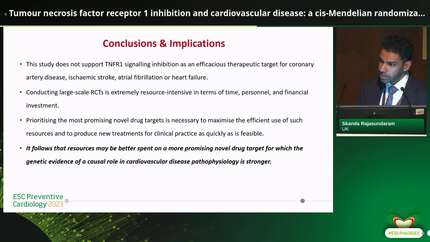
These findings do not support TNFR1 signalling inhibition as likely to be an efficacious therapeutic target for coronary artery disease, ischaemic stroke, atrial fibrillation, or heart failure.
MR Assumptions in this study.
Forest Plot illustrating MR results
Contributors

S Rajasundaram
Author
D Gill
Author
You may be interested in