Infective endocarditis on interventricular communication as cause of massive haemoptysis: a case report
European Heart Journal - Case Reports


Abstract
Haemoptysis is a rare symptom associated with endocarditis. We describe the unusual clinical manifestation of endocarditis on regurgitant bicuspid aortic valve and (probably) secondarily on a perimembranous ventricular septal defect (VSD) as massive haemoptysis.
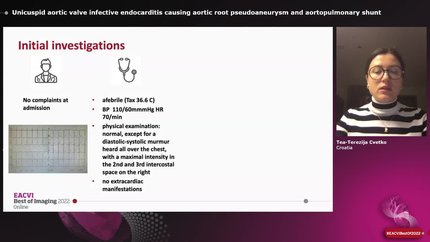
A 24-year-old male with aortic coarctation, bicuspid aortic valve, and VSD since birth. Previously asymptomatic, he came after an episode of haemoptysis. A computed tomography (CT) scan showed a cavitated lesion in lung.
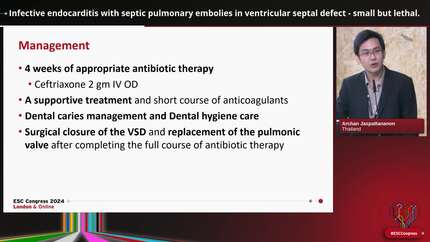
The main debate about this patient’s treatment concerned the indication of surgery, especially after the onset of fever with splenic septic embolism while under appropriate antibiotic treatment. He was stable, with no signs of heart failure and the echocardiogram repeated after the septic splenic embolism showed no residual vegetations on the aortic valve or VSD, and the TEE study ruled out a local complication. Finally, the multidisciplinary team decided against surgical management.
Contributors

Diego Segura-Rodríguez
Author
Eduardo Moreno Escobar
Author
Anastasia Egorova
Author
Mohammed Al-Hijji
Author
A Shaheer Ahmed
Author
Edwina McNaughton
Author
Aiste Monika Jakstaite
Author
You may be interested in