Electrical isolation of the right ventricular outflow tract in idiopathic ventricular tachycardia: a case report
European Heart Journal - Case Reports


Abstract
Ventricular tachycardia (VT) originating in the right ventricular outflow tract (RVOT) is the most common form of idiopathic VT. Catheter ablation of right ventricular outflow tract tachycardia (RVOT-VT) is associated with high success rates. However, non-inducibility of VT on electrophysiological (EP) study can severely impact ablation outcome. We describe a novel catheter ablation strategy which proved feasible and safe in a case of highly symptomatic, non-inducible RVOT-VT.
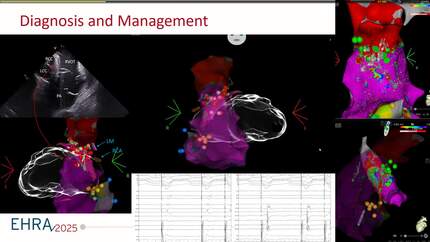
A 51-year-old male with a history of non-sustained VT (NSVT) was referred to our hospital after two syncopal episodes resulting in collapse. Upon admission, a cluster of monomorphic NSVT (250–270 b.p.m.) resulted in haemodynamic instability and required transfer to the intensive care unit. On twelve-lead electrocardiogram, NSVT showed inferior axis and left bundle branch block, suggestive of RVOT-VT. Diagnostic workup including echocardiography, coronary angiography, and late enhancement computed tomography (CT) revealed no evidence of structural heart disease. On two EP studies, non-inducibility of clinical VT despite repeated ventricular pacing and isoproterenol infusion rendered precise mapping of triggered activity unfeasible. Therefore, a bailout ablation strategy was developed by performing a circumferential electrical RVOT isolation using a 3.5 mm irrigated-tip ablation catheter under the guidance of high-density electroanatomic mapping (CARTO® 3) and CT reconstruction of cardiac anatomy. No procedural complications occurred, and the patient remained arrhythmia-free during a 6-month follow-up period.
Catheter ablation is a first-line therapy for symptomatic and drug-refractory idiopathic RVOT-VT. Non-inducibility of RVOT-VT represents a relevant limitation for successful ablation which might be overcome by electrical RVOT isolation as a bailout ablation strategy.
Contributors


Gabriele Hessling
Author
Isabel Deisenhofer
Author
Felix Bourier
Author
David Niederseer
Author
Fabian Barbieri
Author
Robert Schönbauer
Author
Christoph Clemens Kaufmann
Author
Hikmet Kadioglu
Author
Ameenathul Mazaya Fawzy
Author
You may be interested in