Effect of fixed-rate vs. rate-RESPONSIve pacing on exercise capacity in patients with permanent, refractory atrial fibrillation and left ventricular dysfunction treated with atrioventricular junction aBLation and bivEntricular pacing (RESPONSIBLE): a prospective, multicentre, randomized, single-blind study
EP Europace Journal


Abstract
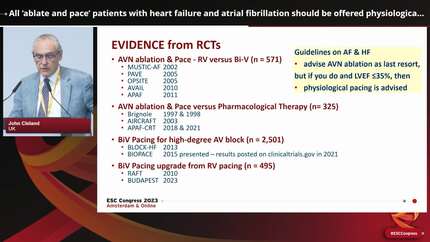
Atrioventricular junction (AVJ) ablation followed by biventricular pacing is an established strategy for improving symptoms and morbidity in patients with permanent atrial fibrillation (AF), reduced left ventricular ejection fraction (LVEF), and uncontrolled ventricular rate. There is no clear evidence that such patients benefit from rate-responsive (RR) pacing.
This prospective, randomized, single-blind, multicentre study was designed as an intra-patient comparison and enrolled 60 patients (age 69.5 ± 11.8 years, males 63.3%, NYHA 3.0 ± 0.6) with refractory AF and reduced LVEF (mean 32.4 ± 8.3%) treated with AVJ ablation and biventricular pacing. Two 6-minute walking tests (6MWT) were performed 1 week apart: one during VVI 70/min biventricular pacing and the other during VVIR 70–130/min biventricular pacing; patients were randomly and blindly assigned to Group A (
In permanent AF patients with uncontrolled rate and reduced LVEF who had undergone AVJ ablation and biventricular pacing, RR pacing yields a significant gain in exercise capacity, which seems to be related to the RR-induced frequency during effort.
Contributors

Vittorio Aspromonte
Author
Ernesto Ammendola
Author
Gabriele Dell'era
Author
Matteo Ziacchi
Author
Federico Guerra
Author
Stefano Aquilani
Author
Giampiero Maglia
Author
Giuseppe Del Giorno
Author
Ailia Giubertoni
Author
Giuseppe Boriani
Author
Alessandro Capucci
Author
Renato Pietro Ricci
Author
Michele Accogli
Author
You may be interested in