Targeted therapy of underlying conditions improves quality of life in patients with persistent atrial fibrillation: results of the RACE 3 study
EP Europace Journal


Abstract
Atrial fibrillation (AF) reduces quality of life (QoL). We aim to evaluate effects of targeted therapy of underlying conditions on QoL in patients with AF and heart failure (HF).
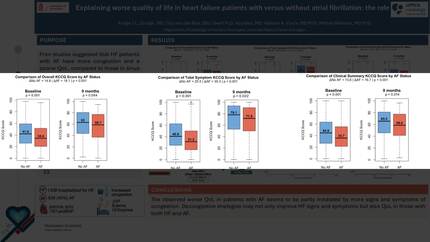
The Routine versus Aggressive risk factor driven upstream rhythm Control for prevention of Early atrial fibrillation in heart failure (RACE 3) study randomized patients with early persistent AF and HF to targeted or conventional therapy. Both groups received guideline-driven treatment. The targeted group received four additional therapies: mineralocorticoid receptor antagonists; statins; angiotensin converting enzyme inhibitors and/or receptor blockers; and cardiac rehabilitation including physical activity, dietary restrictions, and counselling. Quality of life was analysed in 230 patients at baseline and 1 year with available Medical Outcomes Study Short-Form Health Survey (SF-36), University of Toronto AF Severity Scale (AFSS) questionnaires, and European Heart Rhythm Association (EHRA) class. Improvements in SF-36 subscales were larger in the targeted group for physical functioning (Δ12 ± 19 vs. Δ6 ± 22,
A strategy aiming to treat underlying conditions improved QoL more compared with conventional therapy in patients with early persistent AF and HF. Its benefit was even observed in patients in AF at 1 year.
Clinicaltrials.gov NCT00877643.
Contributors

Ruben R De With
Author
Michiel Rienstra
Author
Marcelle D Smit
Author
Bob Weijs
Author
Victor W Zwartkruis
Author
Anne H Hobbelt
Author
Marco Alings
Author
Jan G P Tijssen
Author
Johan Brügemann
Author
Bastiaan Geelhoed
Author
Hans L Hillege
Author
Raymond Tukkie
Author
Martin E Hemels
Author
Robert G Tieleman
Author
Adelita V Ranchor
Author
Dirk J Van Veldhuisen
Author
Harry J G M Crijns
Author

You may be interested in