Regional differences in coronary revascularization procedures and outcomes: a nationwide 11-year observational study

European Heart Journal - Quality of Care and Clinical Outcomes

29 April 2017
Organised by: Logo
ESC Journals

Abstract

AbstractAims

The study investigated whether regional differences in choice of coronary revascularization affected outcomes in Sweden.

Methods and results

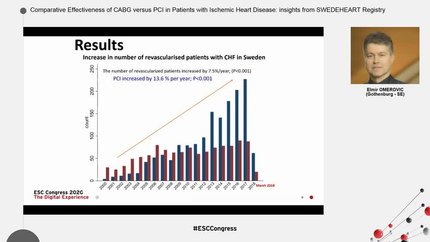
We conducted a prospective nationwide study of outcome in patients undergoing coronary artery bypass grafting (CABG, n = 47 065) or percutaneous coronary intervention (PCI, n = 140 945) from 2001 through 2011, tracked for a median of 5 years. During this period, the proportion of CABG in revascularization procedures decreased nationwide from an average of 38% to 18%e. Three-vessel disease and left main stem coronary artery stenosis were more common among CABG patients than in PCI patients. In both males and females, all-cause mortality was higher in CABG patients than in PCI patients, while repeat PCI was performed more frequently in the PCI group. CABG proportions in 21 counties ranged from 13% to 42% in females and males. The combined outcomes of repeat revascularization, non-fatal acute myocardial infarction, and death during the tracking period was recorded in 151 936 patients without ST-elevation myocardial infarction after PCI (n = 37 820, 36%) and CABG (n = 18 903, 40%). The multivariable adjusted risk of combined outcomes was higher after both PCI and CABG in both females and males in the three quartiles of counties with a smaller proportion of CABG than in the quartile of counties with the highest proportion of CABG. Similar patterns persisted after including only mortality in the analyses.

Conclusion

There are subgroups of patients who have prognostic benefits of CABG in addition to symptomatic improvement that is well documented with both PCI and CABG.

Contributors

Torbjörn Ivert
Torbjörn Ivert

Author

Karolinska Institutet Stockholm , Sweden