Cardiac operations and interventions during the COVID-19 pandemic: a nationwide perspective
EP Europace Journal


Abstract
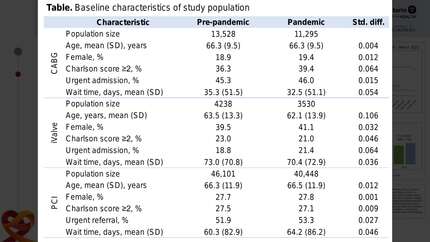
The COVID-19 pandemic has led to a decline in hospitalizations for non-COVID-19-related conditions. We explored the impact of the COVID-19 pandemic on cardiac operations and interventions undertaken in England.
An administrative database covering hospital activity for England, the Health Episodes Statistics, was used to assess a total of 286 697 hospitalizations for cardiac operations and interventions, as well as 227 257 hospitalizations for myocardial infarction (MI) and 453 799 for heart failure (HF) from 7 January 2019 to 26 July 2020. Over the 3 months of ‘lockdown’, total numbers and mean reductions in weekly rates [
The COVID-19 pandemic has led to substantial reductions in the number of cardiac operations and interventions undertaken. An alternative strategy for healthcare delivery to patients with cardiac conditions during the COVID-19 pandemic is urgently needed.
Contributors

Francisco Leyva
Author
Abbasin Zegard
Author
Osita Okafor
Author
Berthold Stegemann
Author
Peter Ludman
Author
Tian Qiu
Author
You may be interested in