Extracorporeal cardiopulmonary resuscitation in out-of-hospital cardiac arrest: a registry study
European Heart Journal


Abstract
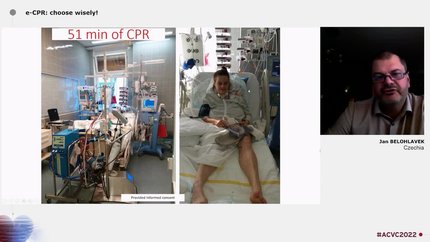
Out-of-hospital cardiac arrest (OHCA) without return of spontaneous circulation (ROSC) despite conventional resuscitation is common and has poor outcomes. Adding extracorporeal membrane oxygenation (ECMO) to cardiopulmonary resuscitation (extracorporeal-CPR) is increasingly used in an attempt to improve outcomes.
We analysed a prospective registry of 13 191 OHCAs in the Paris region from May 2011 to January 2018. We compared survival at hospital discharge with and without extracorporeal-CPR and identified factors associated with survival in patients given extracorporeal-CPR. Survival was 8% in 525 patients given extracorporeal-CPR and 9% in 12 666 patients given conventional-CPR (
In a population-based registry, 4% of OHCAs were treated with extracorporeal-CPR, which was not associated with increased hospital survival. Early ECMO implantation may improve outcomes. The initial rhythm and ROSC may help select patients for extracorporeal-CPR.
Contributors

Wulfran Bougouin
Author
Florence Dumas
Author
Lionel Lamhaut
Author
Eloi Marijon
Author
Pierre Carli
Author
Alain Combes
Author
Romain Pirracchio
Author
Nadia Aissaoui
Author

Nicolas Deye
Author
Georgios Sideris
Author
Frankie Beganton
Author
Daniel Jost
Author
Alain Cariou
Author
Xavier Jouven
Author
F Adnet
Author
J M Agostinucci
Author
N Aissaoui-Balanant
Author
V Algalarrondo
Author
F Alla
Author
C Alonso
Author
W Amara
Author
D Annane
Author
C Antoine
Author
P Aubry
Author
E Azoulay
Author
F Beganton
Author
D Benhamou
Author
C Billon
Author
W Bougouin
Author
J Boutet
Author
C Bruel
Author
P Bruneval
Author
A Cariou
Author
P Carli
Author
E Casalino
Author
C Cerf
Author
A Chaib
Author
B Cholley
Author
Y Cohen
Author
A Combes
Author
M Crahes
Author
D Da Silva
Author
V Das
Author
A Demoule
Author
I Denjoy
Author
N Deye
Author
G Dhonneur
Author
J L Diehl
Author
S Dinanian
Author
L Domanski
Author
D Dreyfuss
Author
D Duboc
Author
J L Dubois-Rande
Author
F Dumas
Author
J P Empana
Author
F Extramiana
Author
M Fartoukh
Author
F Fieux
Author
M Gabbas
Author
E Gandjbakhch
Author
G Geri
Author
B Guidet
Author
F Halimi
Author
P Henry
Author
F Hidden Lucet
Author
P Jabre
Author
L Jacob
Author
L Joseph
Author
D Jost
Author
X Jouven
Author
H Kassim
Author
J Lacotte
Author
K Lahlou-Laforet
Author
L Lamhaut
Author
A Lanceleur
Author
O Langeron
Author
T Lavergne
Author
E Lecarpentier
Author
A Leenhardt
Author
N Lellouche
Author
V Lemiale
Author
F Lemoine
Author
F Linval
Author
T Loeb
Author
B Ludes
Author
C E Luyt
Author
A Maltret
Author
N Mansencal
Author
N Mansouri
Author
E Marijon
Author
J Marty
Author
E Maury
Author
V Maxime
Author
B Megarbane
Author
A Mekontso-Dessap
Author
H Mentec
Author
J P Mira
Author
X Monnet
Author
K Narayanan
Author
N Ngoyi
Author
M C Perier
Author
O Piot
Author
R Pirracchio
Author
P Plaisance
Author
I Plu
Author
M Raux
Author
F Revaux
Author
J D Ricard
Author
C Richard
Author
B Riou
Author
F Roussin
Author
F Santoli
Author
F Schortgen
Author
A Sharifzadehgan
Author
G Sideris
Author
C Spaulding
Author
J L Teboul
Author
J F Timsit
Author
J P Tourtier
Author
P Tuppin
Author
C Ursat
Author
O Varenne
Author
A Vieillard-Baron
Author
S Voicu
Author
K Wahbi
Author
V Waldmann
Author
You may be interested in