Tricuspid regurgitation after cardiac resynchronization therapy: evolution and prognostic significance
EP Europace Journal


Abstract
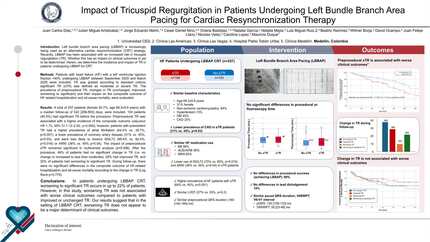
Tricuspid regurgitation (TR) is common in patients with heart failure (HF) and is associated with worse outcome. This study investigated the effect of cardiac resynchronization therapy (CRT) on TR severity and long-term outcome.
Tricuspid regurgitation severity was assessed at baseline and 6 months after CRT implantation, using a multiparametric approach. Patients were divided into four groups: (i) no or mild TR without progression; (ii) no or mild TR with progression to significant (moderate–severe) TR; (iii) significant TR with improvement to no or mild TR; and (iv) significant TR without improvement. The primary endpoint was all-cause mortality. A total of 852 patients (mean age 65 ± 11 years, 77% male) were included. At baseline, 184 (22%) patients had significant TR, with 75 (41%) showing significant improvement at 6-month follow-up. After a median follow-up of 92 (50–137) months, 494 (58%) patients died. Patients with significant TR showing improvement at follow-up had better outcomes than those showing no improvement (
Improvement of significant TR after CRT is observed in a substantial proportion of patients, highlighting the potential benefit of CRT for patients with HF having significant TR. Significant TR at 6 months after CRT is independently associated with increased long-term mortality.
Contributors

Jan Stassen
Author
Xavier Galloo
Author
Nina Ajmone Marsan
Author
Pieter van der Bijl
Author
Victoria Delgado
Author

You may be interested in