QRS micro-fragmentation as a mortality predictor

European Heart Journal

21 February 2022
Organised by: Logo
ESC Journals HEART FAILURE Chronic Heart Failure PREVENTIVE CARDIOLOGY Risk Factors and Prevention

Abstract

AbstractAims

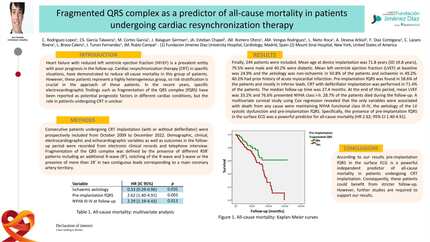
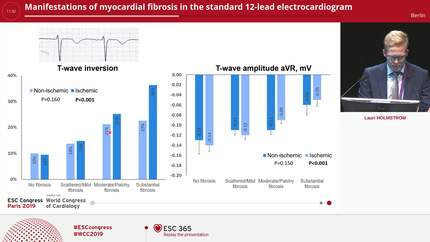
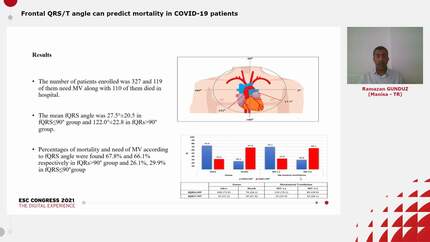
Fragmented QRS complex with visible notching on standard 12-lead electrocardiogram (ECG) is understood to represent depolarization abnormalities and to signify risk of cardiac events. Depolarization abnormalities with similar prognostic implications likely exist beyond visual recognition but no technology is presently suitable for quantification of such invisible ECG abnormalities. We present such a technology.

Methods and results

A signal processing method projects all ECG leads of the QRS complex into optimized three perpendicular dimensions, reconstructs the ECG back from this three-dimensional projection, and quantifies the difference (QRS ‘micro’-fragmentation, QRS-μf) between the original and reconstructed signals. QRS ‘micro’-fragmentation was assessed in three different populations: cardiac patients with automatic implantable cardioverter-defibrillators, cardiac patients with severe abnormalities, and general public. The predictive value of QRS-μf for mortality was investigated both univariably and in multivariable comparisons with other risk factors including visible QRS ‘macro’-fragmentation, QRS-Mf. The analysis was made in a total of 7779 subjects of whom 504 have not survived the first 5 years of follow-up. In all three populations, QRS-μf was strongly predictive of survival (P < 0.001 univariably, and P < 0.001 to P = 0.024 in multivariable regression analyses). A similar strong association with outcome was found when dichotomizing QRS-μf prospectively at 3.5%. When QRS-μf was used in multivariable analyses, QRS-Mf and QRS duration lost their predictive value.

Conclusion

In three populations with different clinical characteristics, QRS-μf was a powerful mortality risk factor independent of several previously established risk indices. Electrophysiologic abnormalities that contribute to increased QRS-μf values are likely responsible for the predictive power of visible QRS-Mf.

Contributors

Tomáš Novotný
Tomáš Novotný

Author

FNUSA Brno , Czechia

Bert Vandenberk
Bert Vandenberk

Author

University Hospitals (UZ) Leuven Leuven , Belgium

Tim Friede
Tim Friede

Author

University Medical Centre of Gottingen (UMG) Goettingen , Germany

Axel Bauer
Axel Bauer

Author

Innsbruck Medical University Innsbruck , Austria

Rik Willems
Rik Willems

Author

University Hospitals (UZ) Leuven Leuven , Belgium

Christian Sticherling

Author

University Hospital Basel Basel , Switzerland

ESC 365 is supported by