Cardiac pacing in severe recurrent reflex syncope and tilt-induced asystole
European Heart Journal


Abstract
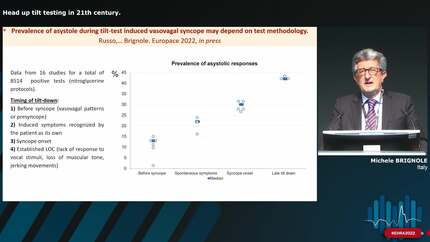
The benefit of cardiac pacing in patients with severe recurrent reflex syncope and asystole induced by tilt testing has not been established. The usefulness of tilt-table test to select candidates for cardiac pacing is controversial.
We randomly assigned patients aged 40 years or older who had at least two episodes of unpredictable severe reflex syncope during the last year and a tilt-induced syncope with an asystolic pause longer than 3 s, to receive either an active (pacing ON; 63 patients) or an inactive (pacing OFF; 64 patients) dual-chamber pacemaker with closed loop stimulation (CLS). The primary endpoint was the time to first recurrence of syncope. Patients and independent outcome assessors were blinded to the assigned treatment. After a median follow-up of 11.2 months, syncope occurred in significantly fewer patients in the pacing group than in the control group [10 (16%) vs. 34 (53%); hazard ratio, 0.23;
In patients aged 40 years or older, affected by severe recurrent reflex syncope and tilt-induced asystole, dual-chamber pacemaker with CLS is highly effective in reducing the recurrences of syncope. Our findings support the inclusion of tilt testing as a useful method to select candidates for cardiac pacing.
ClinicalTrials.gov identifier NCT02324920, Eudamed number CIV-05-013546.
Contributors


Vincenzo Russo
Author
Francesco Arabia
Author
Mario Oliveira
Author
Alonso Pedrote
Author
Arnaud Aerts
Author
Serge Boveda
Author
Jean Claude Deharo
Author
Giampiero Maglia
Author
Gerardo Nigro
Author
Daniele Giacopelli
Author
Alessio Gargaro
Author
Marco Tomaino
Author
You may be interested in