Prognostically relevant periprocedural myocardial injury and infarction associated with percutaneous coronary interventions: a Consensus Document of the ESC Working Group on Cellular Biology of the Heart and European Association of Percutaneous Cardiovascular Interventions (EAPCI)
European Heart Journal


Abstract
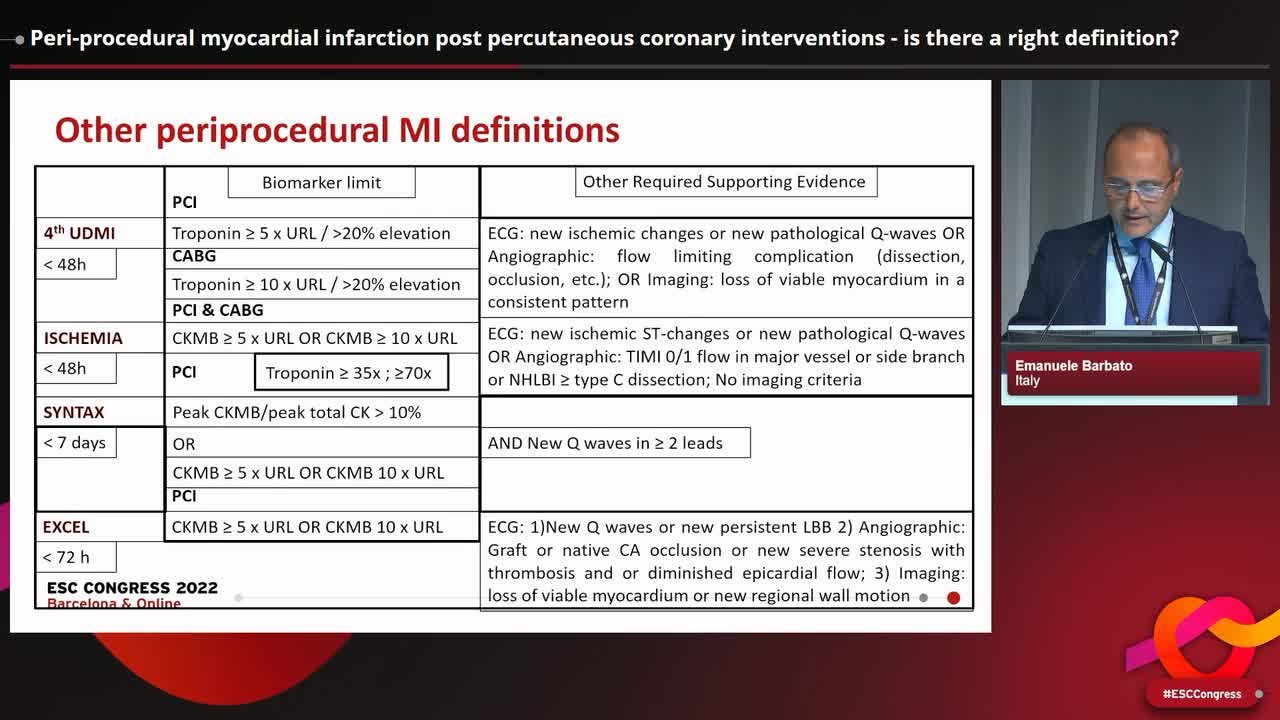
A substantial number of chronic coronary syndrome (CCS) patients undergoing percutaneous coronary intervention (PCI) experience periprocedural myocardial injury or infarction. Accurate diagnosis of these PCI-related complications is required to guide further management given that their occurrence may be associated with increased risk of major adverse cardiac events (MACE). Due to lack of scientific data, the cut-off thresholds of post-PCI cardiac troponin (cTn) elevation used for defining periprocedural myocardial injury and infarction, have been selected based on expert consensus opinions, and their prognostic relevance remains unclear. In this Consensus Document from the ESC Working Group on Cellular Biology of the Heart and European Association of Percutaneous Cardiovascular Interventions (EAPCI), we recommend, whenever possible, the measurement of baseline (pre-PCI) cTn and post-PCI cTn values in all CCS patients undergoing PCI. We confirm the prognostic relevance of the post-PCI cTn elevation >5× 99th percentile URL threshold used to define type 4a myocardial infarction (MI). In the absence of periprocedural angiographic flow-limiting complications or electrocardiogram (ECG) and imaging evidence of new myocardial ischaemia, we propose the same post-PCI cTn cut-off threshold (>5× 99th percentile URL) be used to define prognostically relevant ‘major’ periprocedural myocardial injury. As both type 4a MI and major periprocedural myocardial injury are strong independent predictors of all-cause mortality at 1 year post-PCI, they may be used as quality metrics and surrogate endpoints for clinical trials. Further research is needed to evaluate treatment strategies for reducing the risk of major periprocedural myocardial injury, type 4a MI, and MACE in CCS patients undergoing PCI.
Contributors

Heerajnarain Bulluck
Author
Leeds Teaching Hospitals Leeds , United Kingdom of Great Britain & Northern Ireland

Valeria Paradies
Author

Andreas Baumbach
Author
Hans Erik Bøtker
Author
Davide Capodanno
Author

Claudio Cavallini
Author

Sean M Davidson
Author
University College London London , United Kingdom of Great Britain & Northern Ireland
Dmitriy N Feldman
Author
Péter Ferdinandy
Author
Sebastiano Gili
Author

Vijay Kunadian
Author
Sze-Yuan Ooi
Author
Rosalinda Madonna
Author
Michael Marber
Author
Roxana Mehran
Author
Gjin Ndrepepa
Author

Stefanie Schüpke
Author
Johanne Silvain
Author

Giuseppe Tarantini
Author

Linda W Van Laake
Author
Clemens von Birgelen
Author
Michel Zeitouni
Author

Kristian Thygesen
Author

You may be interested in