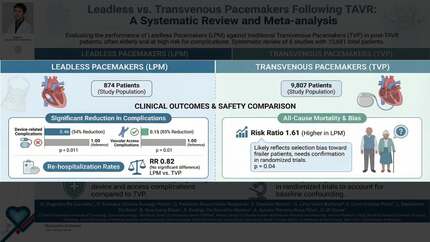
The effect of leadless pacing on LV and RV systolic function is not inferior to conventional RV pacing
European Heart Journal


Abstract
Leadless right ventricular (RV) pacing has been recently proposed as alternative to conventional pacemakers (PM's). While RV pacing with a conventional PM is known to cause deterioration of left ventricular (LV) and RV systolic function over time, the effects of leadless PM's are currently under-explored. In this prospective and randomized study, we hypothesized that the effect of leadless RV pacing over time on both LV and RV systolic function is not inferior to conventional RV pacing.
Fifty-one age-matched patients with a guideline indication for a PM were prospectively recruited and randomized to undergo implantation of either (i) a leadless PM, or (ii) a conventional PM. Patients underwent echocardiography prior to (BL), and at 6 and 12 months (M6 & M12) after PM implantation. All imaging after implantation was performed during active pacing. Analysis included LV ejection fraction (LVEF), LV global longitudinal strain (GLS), and RV free wall (FW) strain.
Twenty-seven patients were implanted with a leadless PM, while twenty-four received a conventional PM. Median age was 82 (80–87) years. At BL, average LVEF and LV GLS were normal and similar in both groups. At M12, both LVEF (−12%) and LV GLS strain (−5%) decreased significantly in both study groups (ANOVA p<0.0001, see Figure 1). RV FW strain decreased only significantly in patients with conventional PM (−4%; ANOVA p=0.031, see Figure 1; post-hoc test BL vs. M12: p=0.029). None of the tested variables, at none of the time points, showed significant difference between the leadless and conventional PM study groups (all p>0.05). Median pacing percentage was 68.2% and similar in both study groups (at all time-points p>0.05).
Both patients with leadless and conventional PM's demonstrate a decrease in LV and RV systolic function, 12 months after implantation. While LV function decrease was similar between both groups, RV function decrease was most prominent in patients treated with conventional PM's. Our data suggest that leadless pacing is not inferior to conventional pacing with regard to the effect on cardiac function.
Type of funding sources: Foundation. Main funding source(s): Research Foundation Flanders (FWO) post-doc grant
Figure 1

You may be interested in