Analysis of myocardial function by deformation imaging in patients with transthyretin gene mutation
European Heart Journal


Abstract
Hereditary transthyretin (TTR) amyloidosis is a rare disease that can affect various organs. The early identification of cardiac involvement through echocardiography allows to corroborate the diagnosis and to start therapy at an early stage.
The aim of our study was to detect early signs of cardiac involvement in patients with TTR gene mutation and neurological phenotype or absence of any organ disease (carriers) compared to patients with TTR gene mutation and cardiac amyloidosis (CA).
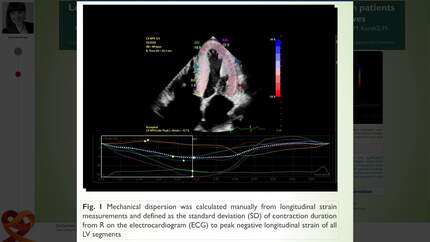
An observational study was conducted on a sample of 31 patients with TTR gene mutation. Patients were divided into 3 groups (23% CA, 42% amyloid neuropathy and 35% carriers). All patients underwent echocardiography with evaluation of left ventricular myocardial deformation indices (apical/basal strain ratio and relative apical sparing).
Carriers and patients with amyloid neuropathy had normal left ventricular systolic and diastolic function. Analyzing left ventricular longitudinal global strain (GLS) we didn't find significant differences between carriers and neuropathy, but we found a significant difference about apical/basal strain ratio and relative apical sparing (respectively 1.33±0.20 vs 1.58±0.25, p value 0.001 and 0.62±0.07 vs 0.72±0.08, p value 0.039).
Relative apical sparing is specific to identify CA; the apical/basal ratio seems to gradually increase from carriers to patients with cardiac amyloidosis and it could be used to monitor patients with TTR mutation, before developing CA.
Type of funding sources: None.
Contributors

F Comparato
Author
D Di Lisi
Author
C Puglisi
Author
M C Portelli
Author
N Cannizzo
Author
G Damerino
Author
L Di Caccamo
Author
A Ortello
Author
A R Galassi
Author
G Novo
Author
You may be interested in