LAV-BPIFB4 isoform modulates eNOS signalling through Ca2+/PKC-alpha-dependent mechanism
Cardiovascular Research


Abstract
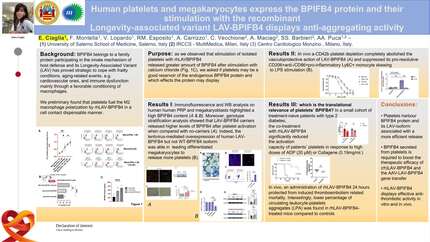
Ageing is associated with impairment of endothelial nitric oxide synthase (eNOS) and progressive reduction in endothelial function. A genetic study on long-living individuals—who are characterized by delays in ageing and in the onset of cardiovascular disease—previously revealed I229V (rs2070325) in bactericidal/permeability-increasing fold-containing-family-B-member-4 (BPIFB4) as a longevity-associated variant (LAV); the LAV protein enhanced endothelial NO production and vasorelaxation through a protein kinase R–like endoplasmic reticulum kinase/14-3-3/heat shock protein 90 signal. Here, we further characterize the molecular mechanisms underlying LAV-BPIFB4-dependent enhancement of vascular function.
LAV-BPIFB4 upregulated eNOS function via mobilization of Ca2+ and activation of protein kinase C alpha (PKCα). Indeed, the overexpression of LAV-BPIFB4 in human endothelial cells enhanced ATP-induced Ca2+ mobilization and the translocation of PKCα to the plasma membrane. Coherently, pharmacological inhibition of PKCα blunted the positive effect of LAV-BPIFB4 on eNOS and endothelial function. In addition, although LAV-BPIFB4 lost the ability to activate PKCα and eNOS in
We have identified novel molecular determinants of the beneficial effects of LAV-BPIFB4 on endothelial function, showing the roles of Ca2+ mobilization and PKCα in eNOS activation and of EDHF when eNOS is inhibited. These results highlight the role LAV-BPIFB4 can have in restoring signals that are lost during ageing.
Contributors

Chiara Carmela Spinelli
Author
Albino Carrizzo
Author
Anna Ferrario
Author
Francesco Villa
Author
Antonio Damato
Author
Mariateresa Ambrosio
Author
Michele Madonna
Author
Giacomo Frati
Author
Sergio Fucile
Author
Miriam Sciaccaluga
Author
Mario Capunzo
Author
Gaetano Calì
Author
Luciano Milanesi
Author
Anna Maciag
Author

You may be interested in