Treatment of atrial fibrillation with doxapram: TASK-1 potassium channel inhibition as a novel pharmacological strategy
Cardiovascular Research


Abstract
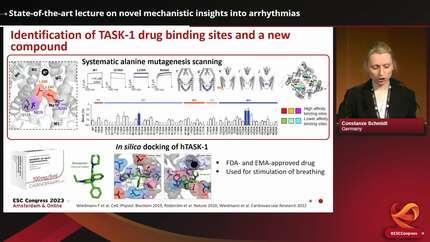
TASK-1 (K2P3.1) two-pore-domain potassium channels are atrial-specific and significantly up-regulated in atrial fibrillation (AF) patients, contributing to AF-related electrical remodelling. Inhibition of TASK-1 in cardiomyocytes of AF patients was shown to counteract AF-related action potential duration shortening. Doxapram was identified as a potent inhibitor of the TASK-1 channel. In this study, we investigated the antiarrhythmic efficacy of doxapram in a porcine model of AF.
Doxapram successfully cardioverted pigs with artificially induced episodes of AF. We established a porcine model of persistent AF in domestic pigs via intermittent atrial burst stimulation using implanted pacemakers. All pigs underwent catheter-based electrophysiological investigations prior to and after 14 days of doxapram treatment. Pigs in the treatment group received intravenous administration of doxapram once per day. In doxapram-treated AF pigs, the AF burden was significantly reduced. After 14 days of treatment with doxapram, TASK-1 currents were still similar to values of sinus rhythm animals. Doxapram significantly suppressed AF episodes and normalized cellular electrophysiology by inhibition of the TASK-1 channel. Patch-clamp experiments on human atrial cardiomyocytes, isolated from patients with and without AF could reproduce the TASK-1 inhibitory effect of doxapram.
Repurposing doxapram might yield a promising new antiarrhythmic drug to treat AF in patients.
Contributors

Ibrahim El-Battrawy
Author
Xin Li
Author
Siegfried Lang
Author
Ursula Tochtermann
Author
Jamila Kremer
Author
Rawa Arif
Author
Matthias Karck
Author
Niels Decher
Author
Gunther van Loon
Author
Felix Wiedmann
Author
Ibrahim Akin
Author
Martin Borggrefe
Author
Christoph Beyersdorf
Author
Stefan Kallenberger
Author
Xiao Bo Zhou
Author

Walter E Haefeli
Author
Manuel Kraft
Author
Hugo A Katus
Author
Amelie Paasche
Author
Natasa Jávorszky
Author

Susanne Rinné
Author

Antonius Büscher
Author
Kathrin I Foerster
Author
Antje Blank
Author
You may be interested in