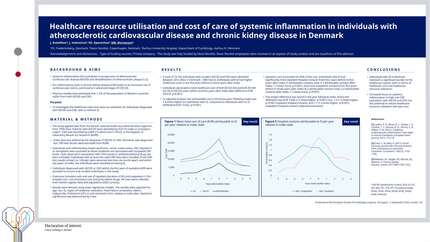
Association between elevated C-reactive protein and mortality, healthcare resource utilization and costs in patients with atherosclerotic cardiovascular disease and/or chronic kidney disease
EHJ - Open


Abstract
Atherosclerotic cardiovascular disease (ASCVD) and chronic kidney disease (CKD) impact health and healthcare systems. Inflammation is a potential modifiable risk factor for both conditions. The case for evaluating the modification of inflammation in these conditions could be strengthened by evidence that systemic inflammation [C-reactive protein ≥2 mg/L] was associated with a considerable health burden.
A retrospective observational cohort study of 179 261 individuals in mutually exclusive cohorts (ASCVD only, CKD stages 3–4 only, ASCVD + CKD stages 3–4) and a reference cohort (no ASCVD or CKD) with ≥1 C-reactive protein measurement after diagnosis. Outcomes included all-cause mortality, healthcare resource utilization (HCRU), and direct healthcare costs. Chronic kidney disease stages 3–4, ASCVD only, and ASCVD + CKD stages 3–4 cohorts compared with the reference cohort were associated with increasing all-cause mortality (death/100 000 person-years) of 1637, 2090, 5163, and 946, respectively. HCRU events per person per year (PPPY) and mean direct costs PPPY were 20.4, 21.4, 34.2, and 8.2 and £2593, £3098, £6810, and £1144, respectively. Within cohorts, all-cause mortality increased progressively across C-reactive protein quartiles (Q) and was highest in Q4 among the ASCVD + CKD stages 3–4 cohort, with a hazard ratio (Q4 vs. Q1) of 2.75 in this cohort compared with 1.22 in the reference cohort.
While the clinical impact of targeting inflammation is being evaluated in ongoing trials, this real-world study demonstrates that assessing inflammation in patients with ASCVD and CKD stages 3–4 can help to identify a population with a high healthcare burden.
Contributors

Kausik K Ray
Author
Imperial College London London , United Kingdom of Great Britain & Northern Ireland


Eline L Huisman
Author
Jimmi Mathisen
Author
Iram Faqir Muhammad
Author
Hongye Ren
Author
Simon Bertram Reuter
Author
Jonathan Pearson-Stuttard
Author
Andrew Thompson
Author
Magnus Bäck
Author
You may be interested in