Impact of obesity on procedural safety and 1-year outcomes after pulsed-field ablation for atrial fibrillation
EP Europace Journal


Abstract
Obesity is associated with atrial fibrillation (AF), atrial remodelling, and cardiometabolic comorbidities. Whether baseline body mass index (BMI) influences procedural safety and effectiveness of pulsed-field ablation (PFA) remains uncertain. We evaluated the association of baseline BMI with procedural characteristics, periprocedural safety, and 1-year arrhythmia recurrence after first-time PFA for AF.
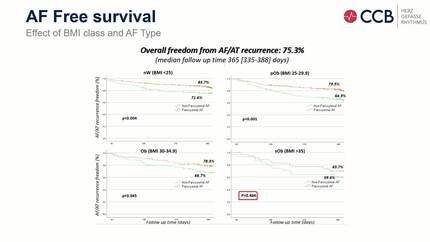
FRANCE-PFA is a nationwide registry including consecutive patients undergoing first-time AF ablation with a pentaspline PFA catheter. Patients with available BMI were categorized as <25, 25 to <30, 30 to <35, or ≥35 kg/m2. Periprocedural complications and 1-year atrial arrhythmia recurrence were assessed across BMI categories. Among 5223 patients, BMI was available in 4573 (87.6%). Higher BMI was associated with greater cardiometabolic burden, more persistent AF, larger atria, and more extensive ablation strategies, including fewer pulmonary vein isolation-only procedures and more additional lesion sets (all
In this nationwide PFA cohort, higher BMI identified a more advanced AF phenotype and more extensive ablation strategies but was not independently associated with periprocedural complications or 1-year arrhythmia recurrence.
Contributors

Grégoire Massoullié
Author
Corentin Chaumont
Author
Mikael Laredo
Author
Bruno Pereira
Author
Olivier Thomas
Author

Pascal Defaye
Author
Serge Boveda
Author

William Escande
Author
Antoine Roux
Author
Franck Raczka
Author
Yves Guyomar
Author


Mathieu Granier
Author
Samir Fareh
Author
Hugo Marchand
Author
Bertrand Pierre
Author
Selim Abbey
Author
Antoine Noel
Author
Antoine Da Costa
Author
Fabrice Extramiana
Author
Olivier Cesari
Author

Ziad Khoueiry
Author
Thibault Villemin
Author
Sarah Traullé
Author
Frédéric Treguer
Author
Hugues Bader
Author
Jean-Claude Deharo
Author
Bruno Degand
Author
Benoît Guy-Moyat
Author
Didier Klug
Author

Alexandre Zhao
Author

Sandrine Venier
Author
Stéphane Combes
Author

Marc Mielczarek
Author

Aymeric Menet
Author
Frédéric Sacher
Author

Romain Eschalier
Author
You may be interested in