Cardiovascular outcomes with potassium binders in patients with heart failure and hyperkalaemia
ESC Heart Failure


Abstract
Hyperkalaemia complicates heart failure (HF) and may limit guideline-directed therapy. Potassium binders differ in pharmacologic properties and sodium load, raising cardiovascular safety concerns. This study compared cardiovascular outcomes associated with patiromer, sodium zirconium cyclosilicate (SZC), and sodium polystyrene sulfonate (SPS).
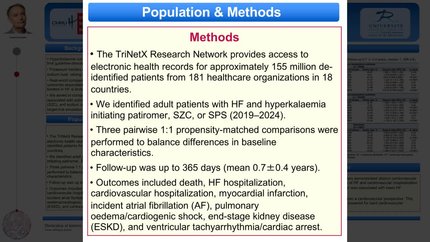
A retrospective observational study was conducted within the TriNetX network including adults with HF and hyperkalaemia initiating patiromer, SZC, or SPS (2019–2024). Three pairwise 1:1 propensity-matched comparisons were performed. Follow-up was up to 365 days (mean 0.7 ± 0.4 years). Outcomes included death, HF hospitalization, cardiovascular hospitalization, myocardial infarction, incident atrial fibrillation (AF), pulmonary oedema/cardiogenic shock, end-stage kidney disease (ESKD), and ventricular tachyarrhythmia/cardiac arrest.
After matching, 5589 patients per group were included for patiromer vs SPS, 15 769 per group for SZC vs SPS, and 4381 per group for SZC vs patiromer. Compared with SPS, patiromer was associated with lower risk of HF hospitalization (hazard ratio [HR] 0.573, 95% confidence interval [CI] 0.535–0.613) and cardiovascular hospitalization (HR 0.737, 95% CI 0.697–0.779), but slightly higher mortality (HR 1.096, 95% CI 1.027–1.170). SZC was associated with higher risks of death (HR 1.139, 95% CI 1.095–1.185), HF hospitalization (HR 1.184, 95% CI 1.143–1.225), myocardial infarction (HR 1.132, 95% CI 1.018–1.260), ESKD (HR 1.137, 95% CI 1.082–1.196), and cardiovascular hospitalization (HR 1.193, 95% CI 1.157–1.229) compared with SPS. SZC was associated with higher HF hospitalization (HR 2.735, 95% CI 2.519–2.969) and cardiovascular hospitalization (HR 1.914, 95% CI 1.797–2.037) than patiromer, with no significant difference in mortality.
In this observational study of HF with hyperkalaemia, potassium binders were associated with different cardiovascular outcomes. These findings are hypothesis-generating and support randomized trials powered for clinical endpoints.
Contributors



You may be interested in