Adults with anomalous aortic origin of a coronary artery: impact of invasive functional testing on clinical decision making—insights from the MuSCAT registry
European Heart Journal - Imaging Methods and Practice


Abstract
In line with the contemporary European Society of Cardiology and American Heart Association/American College of Cardiology guidelines, the work-up for anomalous aortic origin of a coronary artery (AAOCA) should include anatomical and functional evaluation.
This study aims to evaluate the impact of invasive functional testing vs. real-world non-invasive functional testing on the management strategy for adults with potentially malignant AAOCA.
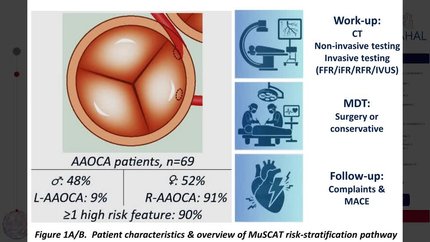
In this multicentre prospective study, all AAOCA patients, ≥16 years, with an interarterial or intraseptal course underwent diagnostic work-up, including anatomic and non-invasive functional evaluation. Invasive functional testing followed the MuSCAT protocol with fractional flow reserve (FFR) or instantaneous wave-free ratio (iFR)/resting full-cycle ratio (RFR), and intravascular ultrasound (IVUS) at baseline and during pharmacological stress. Seventy-six patients [53% female, median age 53 (44–59) years] were included. Sixteen (21%) initially presented with cardiac chest pain. High-risk anatomy, e.g. acute take-off angle <30°, was present in 75 (99%) patients. Non-invasive functional testing was positive in 10 (13%), negative in 59 (78%) and inconclusive in 2 (3%). Invasive functional testing showed discrepant results compared with non-invasive testing in 21 (28%) patients. In 15 (20% of the overall cohort) patients, the treatment recommendation was altered based on the invasive functional testing results.
This study in adult AAOCA patients revealed a 28% discrepancy between non-invasive and invasive functional testing, altering management recommendations for 20% of the overall cohort. Implementing optimal functional testing modalities may enhance risk stratification for ischaemic events and sudden cardiac death, enabling tailored treatment strategies for AAOCA patients. Further prospective research with long-term follow-up is needed to evaluate clinical outcomes.
Registered in the Dutch Trial Register #NL8777;
Contributors



Frank van der Kley
Author
C J Koppel
Author
Monique R M Jongbloed
Author

Robbert J de Winter
Author
Michiel Voskuil
Author
Michael G Dickinson
Author
Peter Damman
Author
Lodewijk J Wagenaar
Author
Marco C Post
Author
Dave R Koolbergen
Author
Mark G Hazekamp
Author

J Wouter Jukema
Author
Philippine Kiès
Author
Hubert W Vliegen
Author
You may be interested in