Purkinje network and myocardial substrate at the onset of human ventricular fibrillation: implications for catheter ablation
European Heart Journal


Abstract
Mapping data of human ventricular fibrillation (VF) are limited. We performed detailed mapping of the activities underlying the onset of VF and targeted ablation in patients with structural cardiac abnormalities.
We evaluated 54 patients (50 ± 16 years) with VF in the setting of ischaemic (
The onset of human VF is sustained by activities originating from Purkinje and structural substrate, before spreading throughout the ventricles to establish disorganized VF. Targeted ablation results in effective reduction of VF burden.
The initial phase of human ventricular fibrillation (VF) is critical as it involves the primary activities leading to sustained VF and arrhythmic sudden death. The origin of such activities is unknown.
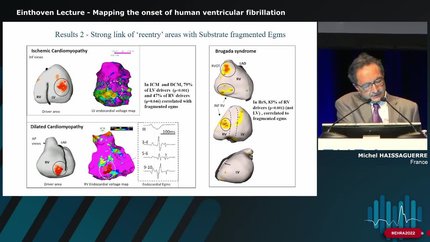
Body-surface mapping shows that most drivers (≈80%) during the initial VF phase originate from electrophysiologically defined structural substrates. Repetitive Purkinje activities can be elicited by programmed stimulation and are implicated as drivers in 37% of cardiomyopathy patients.
The onset of human VF is mostly associated with activities from the Purkinje network and structural substrate, before spreading throughout the ventricles to establish sustained VF. Targeted ablation reduces or eliminates VF recurrence.
Contributors

Thomas Pambrun
Author

Louis Labrousse
Author
Mark Strik
Author

Hugh Calkins
Author

Ed Vigmond
Author
Koonlawee Nademanee
Author
Olivier Bernus
Author
Ghassen Cheniti
Author
Remi Dubois
Author
Meleze Hocini
Author
Frederic Sacher
Author

Hubert Cochet
Author
Laura Bear
Author
Romain Tixier
Author


Elodie Surget
Author
Tsukasa Kamakura
Author
Hugo Marchand
Author
Nicolas Derval
Author
Pierre Bordachar
Author
Sylvain Ploux
Author
You may be interested in