Systematic, early rhythm control strategy for atrial fibrillation in patients with or without symptoms: the EAST-AFNET 4 trial
European Heart Journal


Abstract
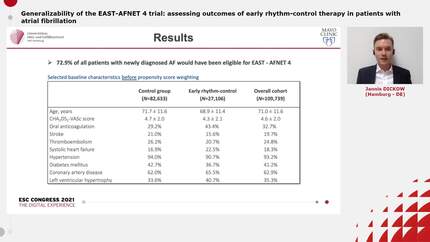
Clinical practice guidelines restrict rhythm control therapy to patients with symptomatic atrial fibrillation (AF). The EAST-AFNET 4 trial demonstrated that early, systematic rhythm control improves clinical outcomes compared to symptom-directed rhythm control.
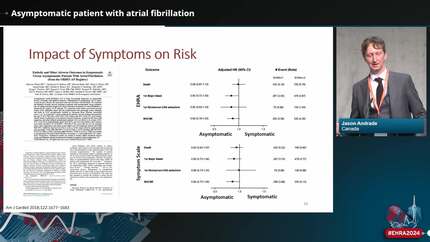
This prespecified EAST-AFNET 4 analysis compared the effect of early rhythm control therapy in asymptomatic patients (EHRA score I) to symptomatic patients. Primary outcome was a composite of death from cardiovascular causes, stroke, or hospitalization with worsening of heart failure or acute coronary syndrome, analyzed in a time-to-event analysis. At baseline, 801/2633 (30.4%) patients were asymptomatic [mean age 71.3 years, 37.5% women, mean CHA2DS2-VASc score 3.4, 169/801 (21.1%) heart failure]. Asymptomatic patients randomized to early rhythm control (395/801) received similar rhythm control therapies compared to symptomatic patients [e.g. AF ablation at 24 months: 75/395 (19.0%) in asymptomatic; 176/910 (19.3%) symptomatic patients,
The clinical benefit of early, systematic rhythm control was not different between asymptomatic and symptomatic patients in EAST-AFNET 4. These results call for a shared decision discussing the benefits of rhythm control therapy in all patients with recently diagnosed AF and concomitant cardiovascular conditions (EAST-AFNET 4; ISRCTN04708680; NCT01288352; EudraCT2010-021258-20).
Contributors

Stephan Willems
Author
Katrin Borof
Author

A John Camm
Author
Harry J G M Crijns
Author
Lars Eckardt
Author
Nele Gessler
Author
Andreas Goette
Author
Laurent M Haegeli
Author
Hein Heidbuchel
Author
Josef Kautzner
Author

G André Ng
Author
University of Leicester Leicester , United Kingdom of Great Britain & Northern Ireland

Anna Suling
Author
Lukasz Szumowski
Author
Sakis Themistoclakis
Author
Panos Vardas
Author
Isabelle C van Gelder
Author
Karl Wegscheider
Author

You may be interested in