
56 year-old male amateur athlete with transient ischemic attack during mountain race

5 February 2017
Organised by: Logo
Practice Tools Open Access Test your knowledge

The case

Description

  • A male amateur athlete (56 years, BMI 22.8 kg/m2) suffered a transient ischemic attack during a mountain race.
  • He now complained of a reduced exercise capacity after a period of no exercise training.
  • Prior to the event, the patient exercised 5 times per week for 1 to 2 hours per session, cross-country skiing during winter and running and cycling during summer, and participated in official competitions.
  • He had a history of arterial hypertension which was treated with an ACE-Inhibitor.
  • Family history was negative for cardiovascular disease.
  • The electrocardiogram showed a normal sinus rhythm, 65 beats per min, without depolarisation or repolarisation abnormalities.
  • A transthoracic echocardiography showed concentric left ventricular remodeling with normal systolic function and first degree diastolic dysfunction, mildly dilated atria, without relevant valvular dysfunction nor pulmonary hypertension.
  • Transoesophageal echocardiography revealed neither thrombi nor persistent foramen ovale.
  • Seven days Holter monitoring revealed no atrial fibrillation.

A cardiopulmonary exercise test was performed for the following questions:

  1. Determination of exercise capacity.
  2. Blood pressure response during exercise.
  3. Heart rate kinetics and exercise-related arrhythmias.
  4. Exercise-related pulmonary hypertension (ventilation-perfusion mismatch)
  5. Determination of training zones based on ventilator thresholds to guide re-uptake of exercise training.

Test findings

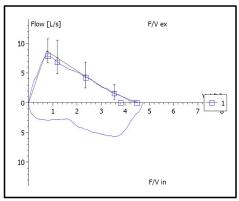
  • The resting spirometry showed a FVC of 4.5 l (99% predicted), a FEV1 of 3.8 l (106% predicted), and a FEV1/FVC of 85%. Estimated maximum voluntary ventilation (MVV, FEV1*40) was 152 l.
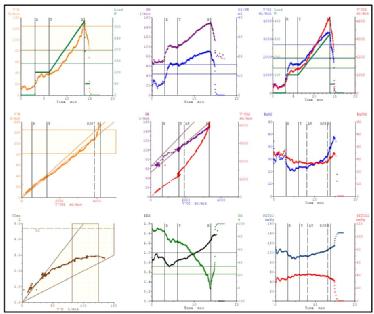
  • A standard ramp protocol for athletic individuals was chosen. The test started with 3 min rest (R), followed by 3 min constant load at 100 watt, followed by a ramp (30 watt/min) (T) until exhaustion, ending with a 4 min recovery period at 50 watt (R) (Panel 3).
  • Exercise capacity was above average with 316 Watt (4.3 Watt/kg, 189 % predicted), and a peak VO2 of 45.8 ml/min/kg (13.1 MET, 146 % predicted) (Panel 3).
  • Blood pressure increased from 130/75 mmHg to 200/95 mmHg at peak exercise.
  • Heart rate increased from 79 beats per min to 148 beats per min (90% predicted).
  • Heart rate recovery in the first min after exercise was 22 beats (Panel 2).
  • No arrhythmias or ST depressions occurred.
  • Maximum rate pressure product was 29600 mmHg/min.
  • Maximum respiratory exchange ratio was 1.22 (Panel 8).
  • The patient was exhausted at the end of the test (Borg 19/20).
  • Maximum ventilation was 135 l (Panel 1)
  • Breathing reserve ((1-VEmax/MVV)*100) was 11% (Panel 8).
  • Respiratory efficiency, determined by the VE/VCO2 slope was 25 (Panel 4).
  • Peak PETCO2 was 42 mmHg (Panel 9).
  • The O2 pulse (VO2/heart rate) increased to 22.6 ml (170% of predicted, Panel 2).
  • The VO2/work rate slope was 8.8 ml/min/watt (Panel 3).
  • The first ventilatory threshold (anaerobic threshold, AT) could be determined in Panel 6 (increase in EqO2) and Panel 9 (increase in PETO2), but not in Panel 5.
  • The second ventilatory threshold (respiratory compensation point, RCP) could be determined in Panel 6 (increase in EqCO2), and Panel 9 (decrease in PETCO2), and could be confirmed in Panel 4 (increase in VE/VCO2 slope).

Spirometry

SpirometryFeb2017_escardio-hPhotoSmall.jpg


9 Panel Plot of the Cardiopulmonary Exercise Test

9 Panel Plot Feb 2017_escardio-hPhotoMedium.jpg


References

  • Guazzi M, Arena R, Halle M, Piepoli MF, Myers J, Lavie CJ. 2016 focused update: Clinical recommendations for cardiopulmonary exercise testing data assessment in specific patient populations. Eur Heart J. 2016: DOI 10.1093/eurheartj/ehw180
  • Guazzi M, Adams V, Conraads V, Halle M, Mezzani A, Vanhees L, Arena R, Fletcher GF, Forman DE, Kitzman DW, Lavie CJ, Myers J, Eacpr, Aha. Eacpr/aha joint scientific statement. Clinical recommendations for cardiopulmonary exercise testing data assessment in specific patient populations. Eur Heart J. 2012;33:2917-2927
  • Wasserman et al. Principles of Exercise Testing and Interpretation, Lippincott Williams & Williams 2005.

Of interest:

Other Cardiopulmonary Exercise Testing cases

Notes to editor

Dr. Matthias Wilhelm, MD, FESC, Dept. of Cardiology, University Hospital of Bern, Switzerland

Contributors

ESC 365 is supported by